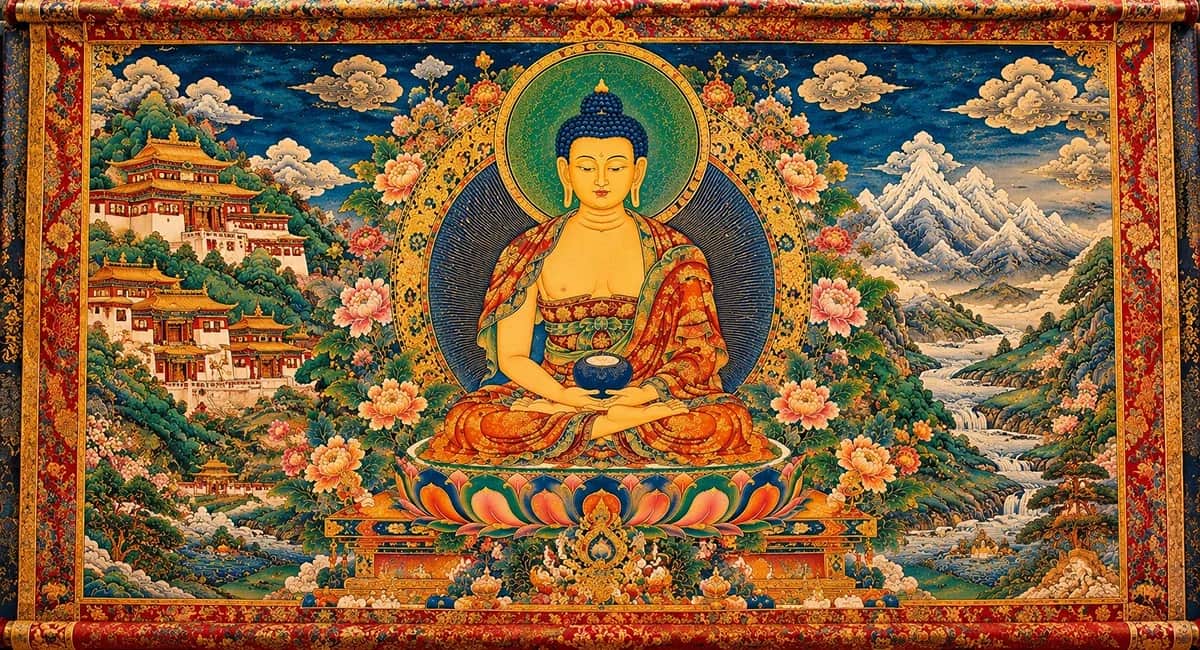
Peaceful vs Wrathful Deities in Tibetan Buddhism: Their Meaning and Symbolism
By Nepathangka Editorial, Editorial Team
, 9 min read
Explore the differences between peaceful and wrathful deities in Tibetan Buddhist art. Learn what their expressions, colours, gestures, and symbolic objects represent in traditional Thangka paintings.
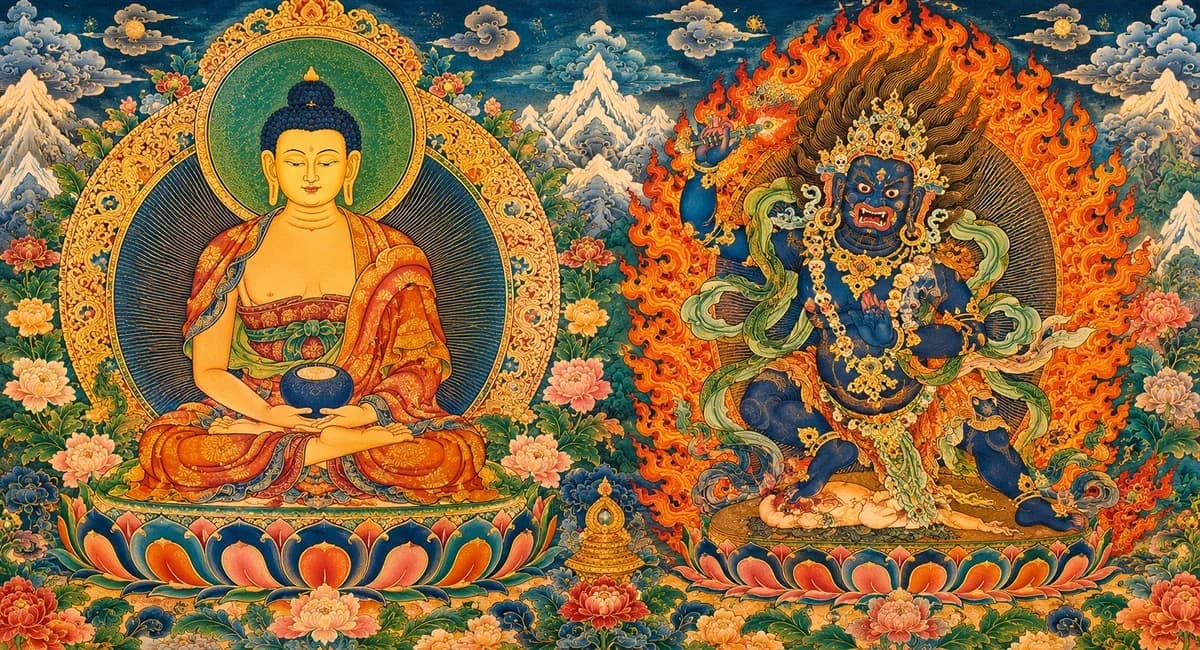
Tibetan Buddhist art represents enlightened qualities through both peaceful and wrathful deities. While peaceful figures often express compassion, wisdom, and calm awareness, wrathful figures communicate powerful enlightened activity and the overcoming of ignorance. Understanding the symbolism behind these different forms helps viewers appreciate the deeper meaning of traditional Thangka paintings and Tibetan Buddhist iconography.
Tibetan Buddhist art is known for its beautiful representations of Buddhas, Bodhisattvas, meditational deities, and spiritual protectors. Some figures appear calm and compassionate, while others have fierce expressions, multiple arms, flaming halos, and powerful symbolic objects. These different appearances are known as peaceful and wrathful forms.
The distinction between peaceful and wrathful deities in Tibetan Buddhism is an important part of Buddhist iconography. Peaceful figures commonly communicate qualities such as compassion, wisdom, and tranquillity, while wrathful figures express powerful enlightened activity directed towards overcoming ignorance and obstacles.
Although their appearances are very different, peaceful and wrathful deities are not simply good and evil opposites. Both forms can communicate different aspects of Buddhist teachings. Traditional Thangka paintings use colours, gestures, ornaments, and carefully arranged compositions to express these meanings.
1. What Are Peaceful and Wrathful Deities in Tibetan Buddhism?
Peaceful and wrathful deities are two important visual forms found in Tibetan Buddhist religious art.
Peaceful deities are generally shown with calm expressions, balanced postures, and gentle gestures. They often represent compassion, loving-kindness, wisdom and enlightened awareness.
Wrathful deities, on the other hand, appear powerful and fierce. Their expressions may include wide eyes, exposed fangs, flaming hair and elaborate ornaments. These features symbolise the ability of enlightened activity to overcome ignorance, harmful tendencies and obstacles to spiritual progress.
The appearance of a deity does not necessarily indicate whether it is compassionate or harmful. In Tibetan Buddhist traditions, even a frightening figure may represent enlightened wisdom and protection.
2. Peaceful Deities: Meaning and Symbolism
Peaceful deities are among the most recognisable subjects in Tibetan Buddhist art. They are commonly represented with gentle facial expressions, graceful bodies and calm sitting or standing postures.
Their appearance communicates spiritual qualities that practitioners seek to develop, including compassion, patience, wisdom and mental clarity.
Some peaceful figures wear crowns, necklaces and other ornaments, while others are depicted with simpler monastic clothing. Their hands may form meaningful gestures known as mudras or hold objects associated with their identities.
Common Features of Peaceful Deities
- Calm expressions: Their gentle faces communicate tranquillity and compassion.
- Balanced postures: They are often seated in meditation or standing gracefully.
- Lotus thrones: The lotus commonly represents purity and spiritual development.
- Peaceful objects: They may hold lotus flowers, texts, vases, or other symbolic attributes.
- Soft halos: Their surroundings may include circular halos or decorative light patterns.
These features help viewers recognise the spiritual qualities represented by the central figure.
3. Examples of Peaceful Deities in Tibetan Buddhist Art
Several well-known Buddhist figures are commonly represented in peaceful forms.
Shakyamuni Buddha
Shakyamuni Buddha represents the historical Buddha and the attainment of enlightenment. In Thangka paintings, he is commonly shown seated in meditation, wearing monastic robes and displaying the earth-touching gesture, known as Bhumisparsha Mudra.
His peaceful expression and balanced posture communicate awareness, wisdom, and liberation.
Avalokiteshvara (Chenrezig)
Avalokiteshvara is the Bodhisattva associated with compassion. In Tibetan Buddhism, he is widely known as Chenrezig.
He appears in several forms, including depictions with multiple arms. These arms can symbolise the many ways compassion reaches and helps living beings.
Green Tara
Green Tara is associated with compassionate activity and the swift response to difficulties. She is often depicted seated with one leg extended, suggesting readiness to act.
Her green colour and characteristic hand gestures are important parts of her traditional iconography.
Manjushri
Manjushri represents wisdom. He is often shown holding a sword associated with cutting through ignorance and a text connected with the perfection of wisdom.
His peaceful appearance reflects the clarity and understanding associated with enlightened knowledge.
4. Wrathful Deities: Meaning and Symbolism
Wrathful deities are among the most visually dramatic figures in Tibetan Buddhist art. Their appearance may include fierce eyes, open mouths, sharp teeth, flaming hair, and powerful body postures.
These images are not generally intended to represent ordinary anger or cruelty. In many Vajrayana contexts, wrathful forms symbolise powerful enlightened activity that confronts ignorance, attachment and obstacles to spiritual development.
Their frightening appearance communicates strength and the ability to overcome difficult mental and spiritual challenges.
Wrathful deities may also serve protective roles within particular Buddhist traditions. Their iconography often includes ritual implements, symbolic weapons, and elaborate ornaments.
Common Features of Wrathful Deities
- Fierce expressions: Wide eyes and exposed teeth communicate powerful activity.
- Flaming halos: Flames commonly represent intense enlightened energy.
- Multiple arms and heads: These may express different qualities or activities.
- Symbolic implements: Objects such as vajras, curved knives, and skull cups have specific iconographic meanings.
- Dynamic postures: Their energetic poses communicate the forceful nature of their activity.
The meaning of each feature depends on the particular deity and its tradition.
5. Examples of Wrathful Deities in Tibetan Buddhist Art
Mahakala
Mahakala is a prominent protector figure in Tibetan Buddhist traditions. He is commonly depicted with a dark body, fierce expression, flaming hair, and symbolic ritual objects.
His imagery represents powerful protective activity and the removal of obstacles to Buddhist practice. Different forms of Mahakala are associated with different lineages and traditions.
Yamantaka
Yamantaka is a wrathful meditational deity associated with the transformation of fear, ignorance, and the limitations of ordinary perception.
He is often shown with multiple heads and arms, a buffalo head in many forms, and a dynamic posture. His complex imagery follows specific Vajrayana iconographic traditions.
Vajrapani
Vajrapani is associated with the power of the Buddha's teachings and the protection of Buddhist wisdom. He can appear in both peaceful and wrathful forms.
In wrathful representations, he may be surrounded by flames and hold a vajra, communicating powerful enlightened activity.
Hayagriva
Hayagriva is a wrathful deity found in several Vajrayana traditions. His iconography often includes a horse head emerging above his main head, along with fierce expressions and symbolic attributes.
His appearance and role depend on the particular practice tradition in which he is represented.
6. Peaceful vs Wrathful Deities: Key Differences
Although both forms appear in Tibetan Buddhist art, their visual features often differ.
| Feature | Peaceful Deities | Wrathful Deities |
|---|---|---|
| Expression | Calm and gentle | Fierce and intense |
| Posture | Seated or graceful | Dynamic and powerful |
| Eyes | Usually relaxed | Often wide or bulging |
| Hair | Neatly arranged | Frequently flaming or standing upright |
| Halo | Often a simple or decorative halo | Often surrounded by flames |
| Objects | Lotus, vase, text | Ritual implements and symbolic weapons |
| Main qualities | Compassion and wisdom | Protective and transformative activity |
These are common visual tendencies, not universal rules. Tibetan Buddhist iconography includes many variations, and some deities appear in both peaceful and wrathful forms.
7. What Do the Colours Represent?
Colour is an important part of the visual language of Tibetan Buddhist art. The colours used for peaceful and wrathful figures can help identify their traditional forms and communicate symbolic qualities.
White
White is frequently associated with purity, peace, and clarity. Peaceful figures such as White Tara are commonly represented with a white body.
Green
Green is strongly associated with Green Tara and can communicate active compassion and enlightened activity in her iconographic context.
Blue
Blue appears in several peaceful and wrathful deity forms. Its meaning depends on the particular figure, tradition, and symbolic system.
Red
Red is used in many Buddhist deity representations and may communicate powerful qualities associated with a particular practice or figure.
Gold
Gold details are often used for crowns, jewellery, ornaments and decorative features. They add visual richness and can emphasise the sacred character of the painting.
It is important to remember that colour meanings are not identical across all deities. Their interpretation should be based on the complete iconographic context.
8. Symbolic Objects in Peaceful and Wrathful Thangka Paintings
The objects held by deities are important clues to their identities and meanings.
Lotus Flower
The lotus commonly represents purity, spiritual development, and awakening. It frequently appears with peaceful Buddhas and Bodhisattvas.
Vajra or Dorje
The vajra is a ritual object associated with indestructibility and important aspects of Vajrayana practice. It can appear in the hands of both peaceful and wrathful figures.
Bell
The ritual bell is often associated with wisdom and is frequently paired with the vajra in Vajrayana symbolism.
Curved Knife
The curved knife, often called a kartika, appears in the iconography of certain tantric deities. Its symbolism is associated with cutting through obstacles and aspects of ignorance.
Skull Cup
The skull cup, or kapala, is an important ritual attribute in some wrathful deity representations. Its meaning is connected with specific tantric symbolism and should not be interpreted as an ordinary object.
9. Why Do Some Deities Have Both Peaceful and Wrathful Forms?
One of the most interesting aspects of Tibetan Buddhist iconography is that some enlightened figures can appear in different forms.
The same deity may be represented peacefully in one painting and wrathfully in another. These different appearances communicate different aspects of enlightened activity rather than two unrelated identities.
For example, Avalokiteshvara is widely known in peaceful forms associated with compassion, but Buddhist traditions also include more forceful manifestations of compassionate activity.
This variety shows why the appearance of a figure should not be used as the only basis for understanding its identity or spiritual meaning.
10. Peaceful and Wrathful Deities in the Bardo Tradition
Peaceful and wrathful deities are particularly significant in certain Tibetan Buddhist teachings concerning the bardo, or intermediate state.
Some traditional texts describe visions of peaceful and wrathful figures in the experiences associated with the period following death. These teachings encourage practitioners to recognise the nature of such appearances rather than responding only with fear or confusion.
Thangka paintings depicting peaceful and wrathful deities of the bardo can contain complex arrangements of figures, colours and symbolic details.
The subject demonstrates how the two forms are connected within particular Tibetan Buddhist traditions. Their relationship is not simply a contrast between calmness and anger, but part of a wider teaching about awareness and the recognition of mind.
11. How to Identify Peaceful and Wrathful Deities in a Thangka
When looking at a traditional Thangka painting, begin by observing the central figure.
Notice the facial expression, posture, number of heads and arms, colours, and objects held in the hands. A calm expression and lotus throne may suggest a peaceful representation, while a flaming halo and fierce expression may indicate a wrathful form.
Next, examine the surrounding figures and decorative details. A mandala, attendant deities, ritual implements, or a specific arrangement may provide additional information.
Finally, consider the painting's religious tradition and subject. Similar objects and colours can appear in different deity representations, so it is important not to identify a figure using just one feature.
For more guidance, explore our article on how to read a Thangka painting.
12. The Importance of Peaceful and Wrathful Forms in Thangka Art
Traditional Thangka paintings preserve a detailed visual language developed through Buddhist religious and artistic traditions.
Artists follow established iconographic guidelines when representing deities. These include the proportions of the body, facial expressions, colours, hand gestures, symbolic objects, and surrounding compositions.
Peaceful and wrathful figures also show the diversity of subjects represented in Himalayan Buddhist art. A single collection of Thangkas may include serene Buddhas, compassionate Bodhisattvas, meditational deities and powerful protectors.
To understand the artistic methods behind these representations, read our guide to how a Thangka is painted.
You can also explore the history of Thangka painting to learn how this visual tradition developed over time.
Conclusion
Peaceful and wrathful deities are two important forms in Tibetan Buddhist art. Peaceful figures commonly express compassion, wisdom, and calm awareness, while wrathful figures represent powerful enlightened activity directed towards overcoming ignorance and obstacles.
Their different appearances are communicated through expressions, colours, postures, halos, and symbolic objects. Understanding these details helps viewers appreciate the meaning behind traditional Thangka paintings.
Rather than viewing peaceful and wrathful deities as good and evil opposites, it is more accurate to understand them within their specific Buddhist traditions and iconographic contexts. Together, they reveal the richness, depth, and artistic complexity of Tibetan Buddhist visual culture.
Discover the Beauty of Traditional Tibetan Buddhist Art
Explore Our CollectionFrequently asked questions
Answers to the questions readers ask most about this topic.
Peaceful deities commonly represent compassion, wisdom, and tranquillity, while wrathful deities express powerful enlightened activity associated with overcoming ignorance and obstacles.
No. Many wrathful deities represent enlightened wisdom and protective activity. Their fierce appearance is symbolic and does not necessarily indicate harmful or evil qualities.
Shakyamuni Buddha, Avalokiteshvara, Green Tara, and Manjushri are well-known examples of figures commonly represented in peaceful forms.
Mahakala, Yamantaka, Vajrapani, and Hayagriva are among the well-known wrathful figures represented in Tibetan Buddhist art.
Their fierce expressions symbolise powerful enlightened activity and the ability to overcome ignorance, obstacles and harmful mental tendencies.
About the author: Nepathangka Editorial
Editorial Team
The Nepathangka editorial team writes about thangka painting, Buddhist iconography and Himalayan craft. We work with the painters and metalworkers in Nepal whose pieces we sell, and every guide is checked with the artisans before it goes live.