How to Read a Thangka Painting: Understanding Its Symbols, Figures and Composition
By Nepathangka Editorial, Editorial Team
, 9 min read
Discover how to read a Thangka painting by exploring its central figures, symbolic objects, colours, gestures, and composition. Understand the meaning behind traditional Himalayan Buddhist artwork.
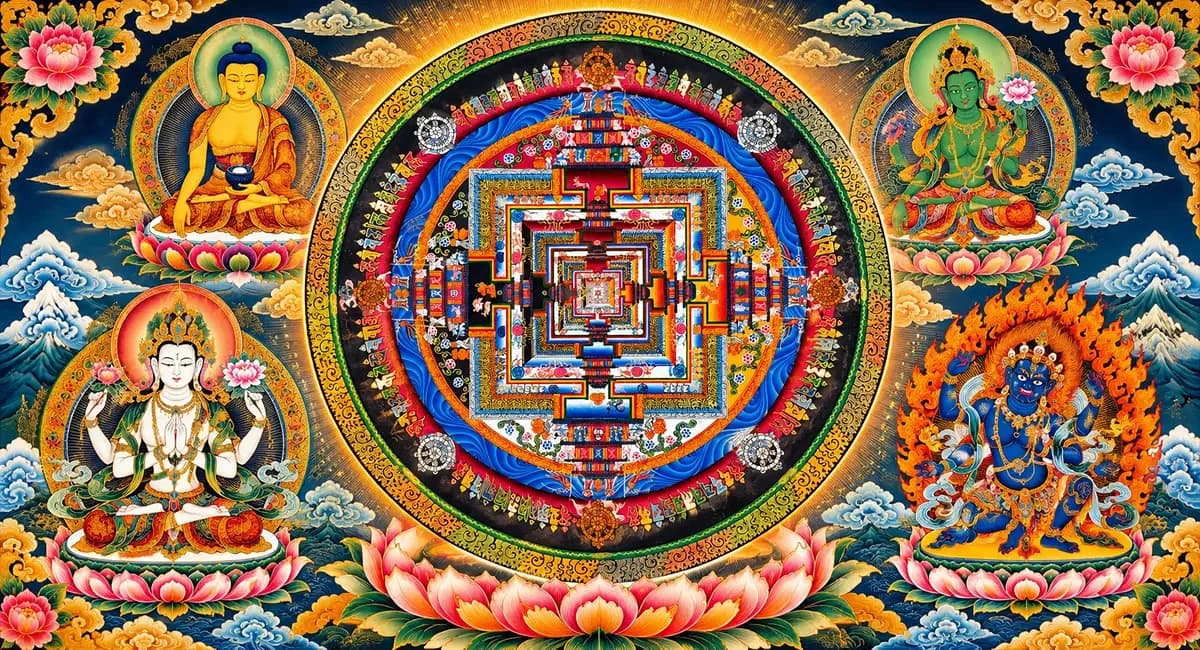
A Thangka painting is more than a beautiful work of traditional Himalayan art. Every figure, colour, gesture, and symbolic object can communicate a deeper meaning connected with Buddhist teachings and spiritual traditions. Learning how to read a Thangka painting helps you understand its composition, recognise important figures, and appreciate the stories represented through its intricate details.
A Thangka painting is much more than a detailed work of traditional Himalayan art. It is a visual representation of Buddhist teachings, spiritual ideas, and sacred figures. Every element, from the central deity and surrounding figures to the colours, hand gestures, and symbolic objects, can communicate a particular meaning.
For someone viewing a Thangka for the first time, its many details may seem difficult to understand. However, learning how to read a Thangka painting becomes easier when you know where to look and what different elements represent.
In this guide, we will explore how to understand Thangka paintings by examining their central figures, symbolic objects, colours, hand gestures, backgrounds, and overall composition.
1. Start by Looking at the Central Figure
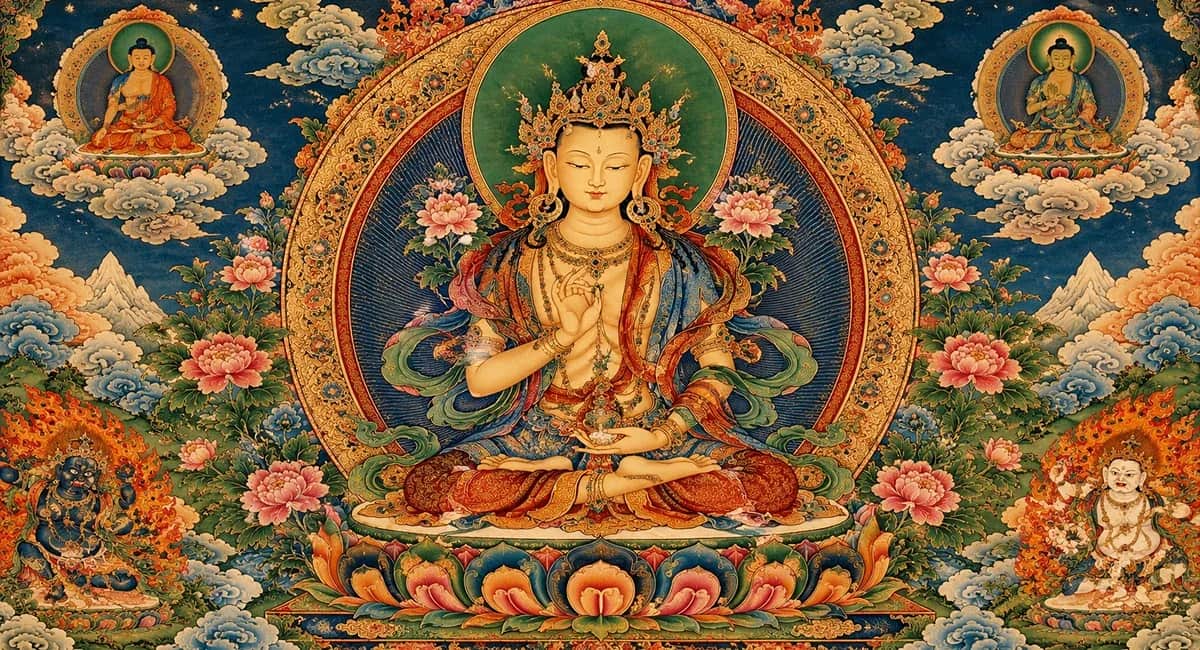
The central figure is often the best place to begin when reading a Thangka painting. Many traditional compositions place a main Buddha, Bodhisattva, teacher or meditational deity in a prominent position.
This figure usually attracts attention through its size, position, posture, and surrounding decoration. In many compositions, smaller figures appear around the central subject as attendants, teachers, or members of a spiritual assembly.
The central figure can provide the first clue about the painting's subject. For example:
- Shakyamuni Buddha: Commonly shown seated in meditation and associated with the historical Buddha and his teachings.
- Avalokiteshvara: A Bodhisattva associated with compassion.
- Manjushri: Associated with wisdom and often depicted holding a sword.
- Tara: A female figure associated with compassionate activity and other spiritual qualities.
- Medicine Buddha: Associated with healing and the removal of suffering.
These are useful starting points, but identifying a figure accurately requires looking at its complete set of attributes rather than relying on one feature alone.
2. Understand the Meaning of Hand Gestures (Mudras)
Hand gestures, known as mudras, are important parts of Buddhist iconography. They help communicate the qualities, actions, or teachings associated with a figure.
Some commonly seen gestures include:
Bhumisparsha Mudra
In this gesture, the right hand reaches down towards the earth, with the fingers pointing downward. It is associated with the moment when Shakyamuni Buddha called the earth to witness his enlightenment.
Dhyana Mudra
Both hands rest in the lap, usually with the palms facing upward. This gesture is commonly associated with meditation, concentration, and inner balance.
Abhaya Mudra
One hand is raised with the palm facing outward. It is commonly interpreted as a gesture of reassurance, protection, or fearlessness.
Dharmachakra Mudra
The hands are positioned near the chest in a gesture associated with turning the Wheel of Dharma. It represents the teaching of Buddhist principles.
Varada Mudra
The hand is extended downward with the palm facing outward. It is commonly associated with generosity, giving, and the granting of blessings.
A mudra should always be considered together with the figure, its posture, and the objects shown in the painting. Similar gestures may appear in different iconographic contexts.
3. Recognise the Symbolic Objects
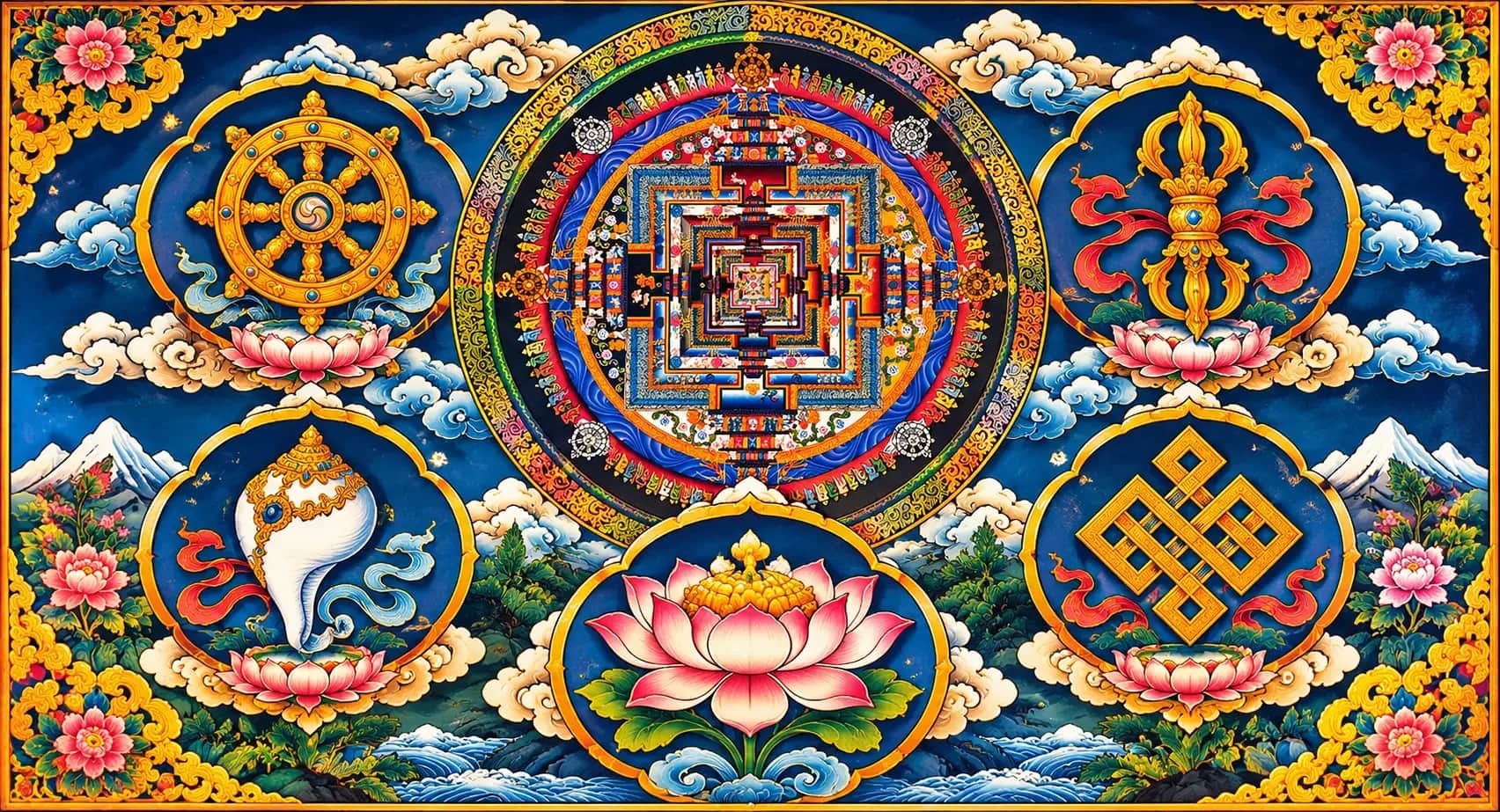
Many Thangka figures hold objects that help identify them and explain their symbolic meaning. These objects are known as attributes in art and iconography.
Some familiar examples include:
- Lotus flower: Often associated with purity and spiritual awakening. It can represent the ability to develop wisdom and compassion while living in the world.
- Vajra: A ritual object associated with spiritual power, firmness, and indestructible qualities.
- Bell: Used in Buddhist ritual traditions and associated with wisdom.
- Flaming sword: Commonly associated with Manjushri and the cutting away of ignorance.
- Water vessel: May appear as an attribute of particular figures and should be interpreted according to the deity depicted.
- Begging bowl: Often associated with the Buddha and the monastic tradition.
The same object may have different meanings depending on the figure and tradition. Therefore, it is useful to examine the entire composition before concluding.
4. Learn How Colours Communicate Meaning
Colours play an important role in Thangka paintings. They make the artwork visually striking, but they can also help identify particular figures and express symbolic qualities.
Some commonly encountered associations include:
- Blue: May represent wisdom, depth, or particular enlightened figures, depending on the context.
- White: Often associated with peace, purity, and peaceful qualities.
- Red: Can be associated with powerful activity, passion transformed through spiritual practice, or specific deities.
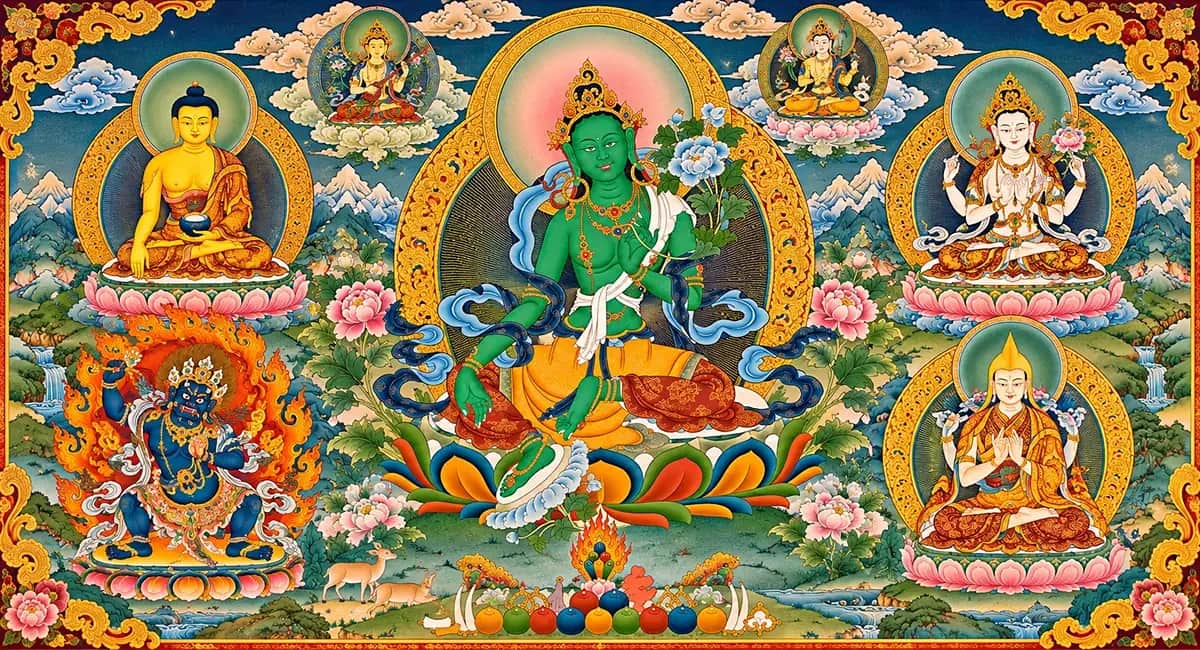
- Green: Frequently connected with active compassion and particular forms of Tara.
- Yellow or Gold: May communicate richness, prosperity, learning or the qualities of specific figures.
These associations are not universal colour rules. A colour's meaning depends on the deity, Buddhist tradition, iconographic instructions, and the role it plays in the painting.
For example, the blue colour of Medicine Buddha is an identifying feature in many traditional representations. Green is a well-known feature of Green Tara. Recognising these visual details can help viewers understand the subject more clearly.
5. Read the Surrounding Figures
A Thangka may contain many smaller figures around the main subject. These figures are not simply decorative additions. They often form part of a meaningful arrangement.
Depending on the painting, the surrounding figures may represent:
- Attendant Bodhisattvas
- Other Buddhas or deities
- Spiritual teachers and lineage masters
- Disciples or religious figures
- Protective deities
- Figures connected with a particular teaching or mandala
Look at how the smaller figures are grouped and positioned. Their relationship with the central figure can help explain the subject and purpose of the artwork.
Some paintings also include a row of teachers near the top or protective figures near the lower section. However, this arrangement is not identical in every Thangka.
6. Understand the Composition and Layout
Composition refers to how the figures, objects, colours, and background elements are organised within the painting.
A common arrangement places the principal figure in the centre, with smaller figures arranged around it. The central subject may be larger than the surrounding figures to establish its visual importance.
Other common compositions include:
Single-figure composition: A single Buddha or deity occupies most of the painting, with limited surrounding imagery.
Multiple-figure composition: Several Buddhas, Bodhisattvas, attendants or other sacred figures appear together.
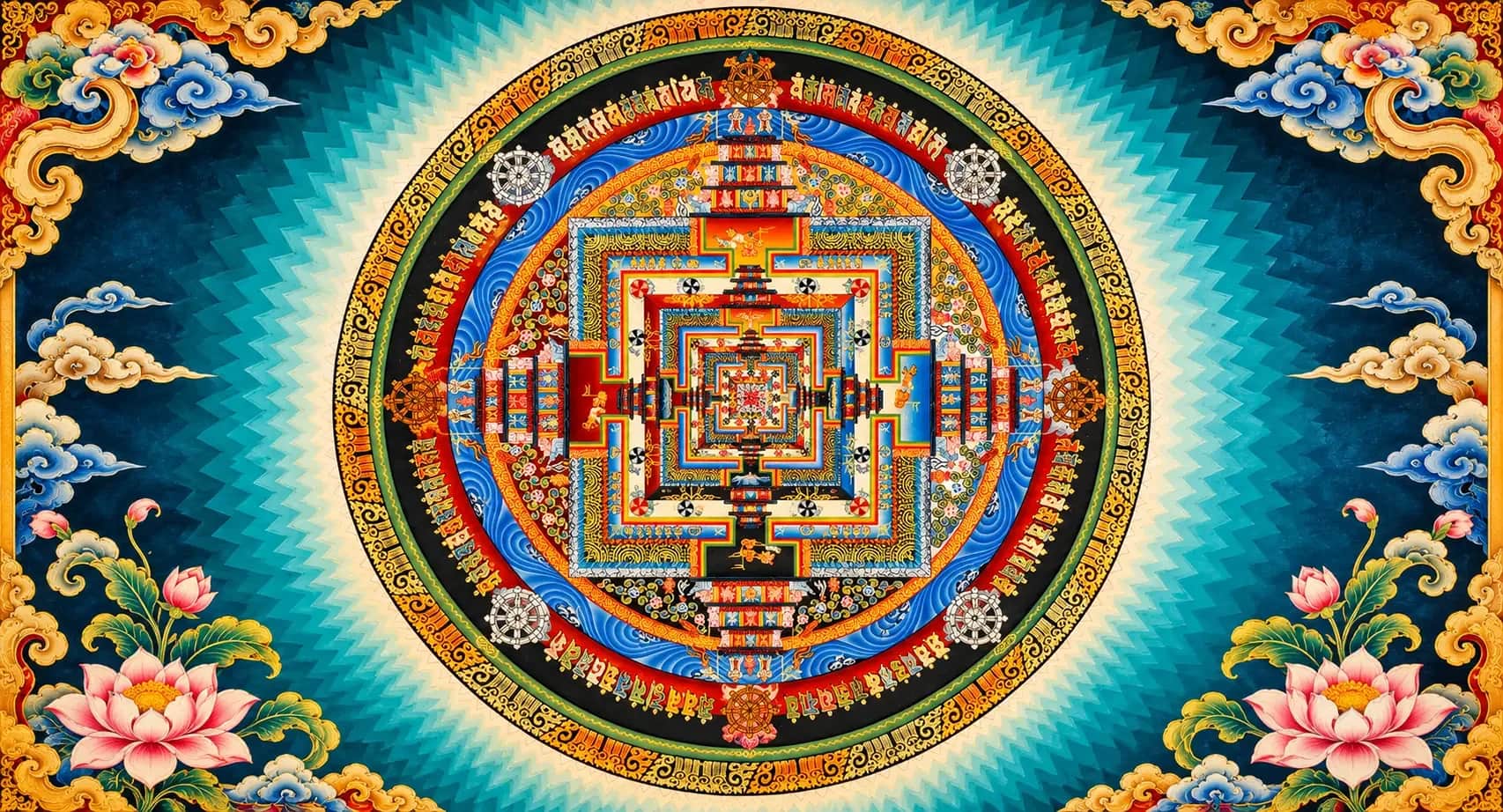
Mandala composition: Geometric arrangements organise sacred figures and spaces according to a specific symbolic or ritual structure.
Narrative composition: Multiple scenes or episodes are represented within one painting to communicate a story or teaching.
Understanding the layout helps viewers recognise whether a Thangka is focused on one sacred figure, a group of deities, a spiritual lineage, or a visual explanation of Buddhist ideas.
7. Look at the Background and Landscape
The background of a Thangka can contain mountains, clouds, water, trees, flowers, buildings and other decorative elements. These details contribute to the overall meaning and visual atmosphere of the artwork.
In many traditional paintings, landscapes are stylised rather than realistic. They may represent a sacred environment, a symbolic setting or a place connected with a particular story.
A landscape can also help separate different groups of figures and create visual balance. Clouds, lotus flowers and architectural elements may be used to frame the central subject.
Do not assume that every background object has one fixed meaning. Its interpretation depends on the painting's subject and artistic tradition.
8. Notice the Halo, Throne and Decorative Details
Halos, aureoles and elaborate thrones are important visual features in many Thangka paintings.
A halo is commonly placed around the head or body of a sacred figure. It can indicate spiritual radiance or an enlightened presence. Some paintings use a circular halo, while others feature elaborate flame-shaped or ornamental designs.
Lotus thrones are also frequently seen. The lotus is an important symbol in Buddhist art and is associated with purity and spiritual awakening.
Decorative details such as crowns, jewellery, ornaments, and patterned clothing can help identify the type of figure represented. They also demonstrate the artist's attention to traditional design and craftsmanship.
9. Understand the Role of Mandalas in Thangka Art
A mandala is a sacred geometric arrangement found in many Buddhist traditions. Mandala Thangkas often contain a central figure or symbolic centre surrounded by carefully organised shapes, figures and architectural forms.
The design may include circles, squares, gates and different levels of symbolic space. Each part contributes to the overall structure.
When reading a mandala painting, begin with its centre and then examine the surrounding sections. Notice the symmetry, repeated patterns, and placement of figures.
Mandalas can communicate complex ideas about sacred space and spiritual practice. Their interpretation may require knowledge of the specific Buddhist tradition in which the painting was created.
10. How to Read a Thangka Painting Step by Step
If you are looking at a Thangka and do not know where to begin, follow this simple approach:
- Identify the central figure: Look at the main subject and its position.
- Observe the posture: Notice whether the figure is seated, standing or shown in a dynamic pose.
- Examine the hand gestures: Look for mudras that may communicate a particular teaching or quality.
- Identify symbolic objects: Check whether the figure holds a lotus, vajra, sword, bowl or another attribute.
- Notice the colours: Observe the colours of the body, clothing and background.
- Study the surrounding figures: Identify attendants, teachers, protectors or other deities.
- Explore the background: Look at the landscape, halo, throne and decorative details.
- Consider the overall subject: Use all the visual clues together before deciding what the painting represents.
This method will not identify every Thangka automatically, but it provides a useful foundation for appreciating its visual language.
11. Why Understanding Thangka Symbols Matters
Learning to read Thangka paintings helps viewers appreciate the artwork beyond its decorative appearance. It reveals how traditional artists use visual details to communicate religious teachings, spiritual qualities, and cultural stories.
It also encourages a deeper appreciation of the knowledge involved in creating these paintings. Traditional artists learn established proportions, iconographic guidelines, symbolic attributes, and painting techniques through years of practice.
If you would like to learn more about the artistic process, explore our guide on How a Thangka Is Painted.
You can also discover What a Thangka Is Used For to understand its role in meditation, Buddhist teaching, and spiritual practices.
12. The Cultural and Artistic Importance of Thangka Paintings
Thangka paintings preserve an important part of Himalayan Buddhist art and cultural heritage. They bring together artistic craftsmanship, religious iconography, and traditional knowledge.
Across generations, artists have maintained established methods for representing sacred figures and arranging compositions. These traditions help preserve the visual language of Buddhist art while allowing individual artists to express their skill through colour, detail and decorative elements.
To understand how this art form developed over time, read our article on the History of Thangka Painting.
Conclusion
Reading a Thangka painting becomes easier when you understand the relationship between its central figure, hand gestures, symbolic objects, colours and composition. Each element can provide a clue about the subject and the ideas represented in the artwork.
Rather than focusing on one symbol alone, take time to observe the entire painting. Notice how the figures are arranged, what they hold, how they are positioned, and how the background supports the composition.
With patience and a little knowledge of Buddhist iconography, viewers can develop a deeper appreciation for the meaning, craftsmanship, and cultural heritage of traditional Thangka paintings.
Discover the Meaning Behind Traditional Thangka Art
Explore Our CollectionFrequently asked questions
Answers to the questions readers ask most about this topic.
Start by identifying the central figure, then examine its hand gestures, symbolic objects, colours, surrounding figures, and background. These elements help explain the painting's subject and meaning.
Symbols represent different Buddhist teachings and spiritual qualities. For example, the lotus commonly symbolizes purity, while the vajra represents indestructible spiritual qualities.
Colours can communicate different qualities and help identify sacred figures. Their meanings depend on the deity, Buddhist tradition, and the painting's context.
Hand gestures, known as mudras, communicate particular teachings or qualities. Examples include meditation, fearlessness, generosity, and the turning of the Wheel of Dharma.
In many traditional compositions, the central figure is shown larger to establish its visual importance. Smaller figures may represent attendants, teachers, or other beings connected with the main subject.
About the author: Nepathangka Editorial
Editorial Team
The Nepathangka editorial team writes about thangka painting, Buddhist iconography and Himalayan craft. We work with the painters and metalworkers in Nepal whose pieces we sell, and every guide is checked with the artisans before it goes live.