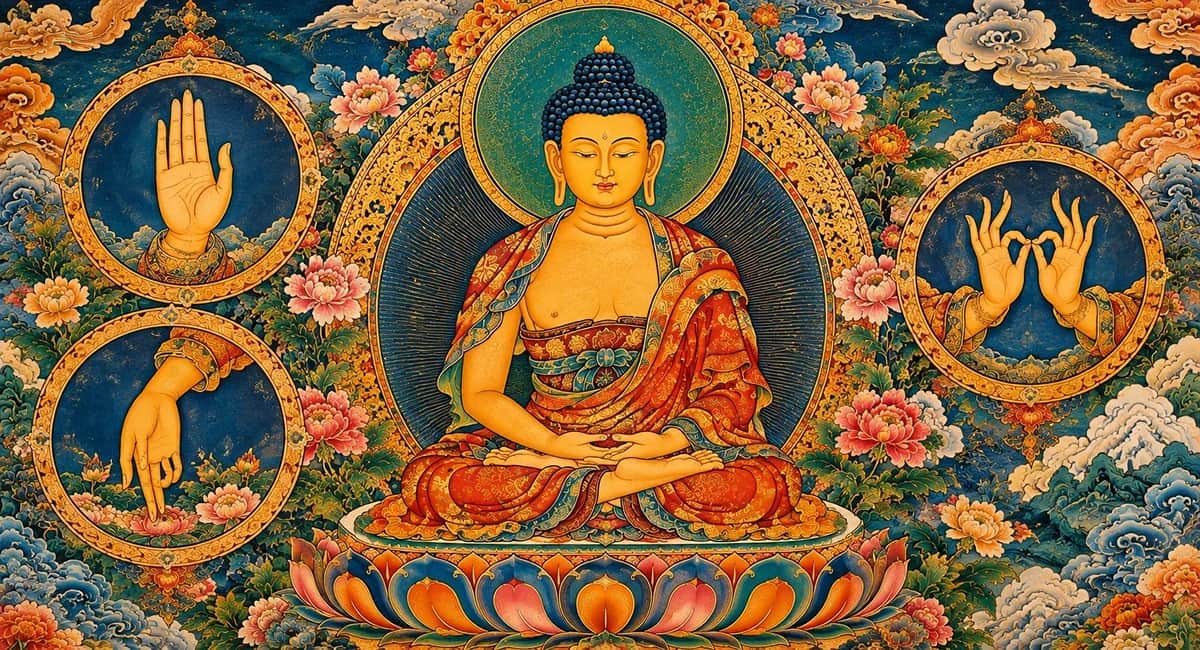
What Do the Colours in Thangka Paintings Represent?
By Nepathangka Editorial, Editorial Team
, 9 min read
Explore the meaning of colours in traditional Thangka paintings. Learn how blue, white, red, green, and yellow communicate spiritual qualities, symbolism, and Buddhist teachings.
Colours play an important role in traditional Thangka paintings. Beyond their visual beauty, different colours can communicate spiritual qualities, represent sacred figures, and express ideas from Buddhist philosophy. From the peaceful appearance of white to the powerful symbolism of deep blue and red, understanding these colours helps viewers appreciate the deeper meaning behind Himalayan Buddhist artwork.
Thangka paintings are admired for their intricate details, sacred figures, and rich colours. These traditional Himalayan Buddhist artworks are not simply decorative paintings. They communicate spiritual teachings, religious stories and symbolic ideas through carefully arranged figures, objects, patterns and colours.
One of the most interesting features of Thangka art is the way colours contribute to its meaning. Blue, white, red, green and yellow are commonly seen in traditional Buddhist paintings. Each colour can be associated with particular spiritual qualities, enlightened figures and symbolic concepts.
However, colour symbolism is not always the same in every painting. Its meaning can depend on the deity, Buddhist tradition, composition, and context in which it appears.
In this guide, we explore what the colours in Thangka paintings represent and how they help communicate the deeper meaning of traditional Buddhist artwork.
1. Why Are Colours Important in Thangka Paintings?
Colour is an essential part of traditional Thangka painting. Artists use different shades not only to create visual beauty but also to communicate the qualities of sacred figures and the ideas represented in the artwork.
In Buddhist art, colours help viewers recognise particular deities, understand symbolic relationships, and appreciate a composition's spiritual themes.
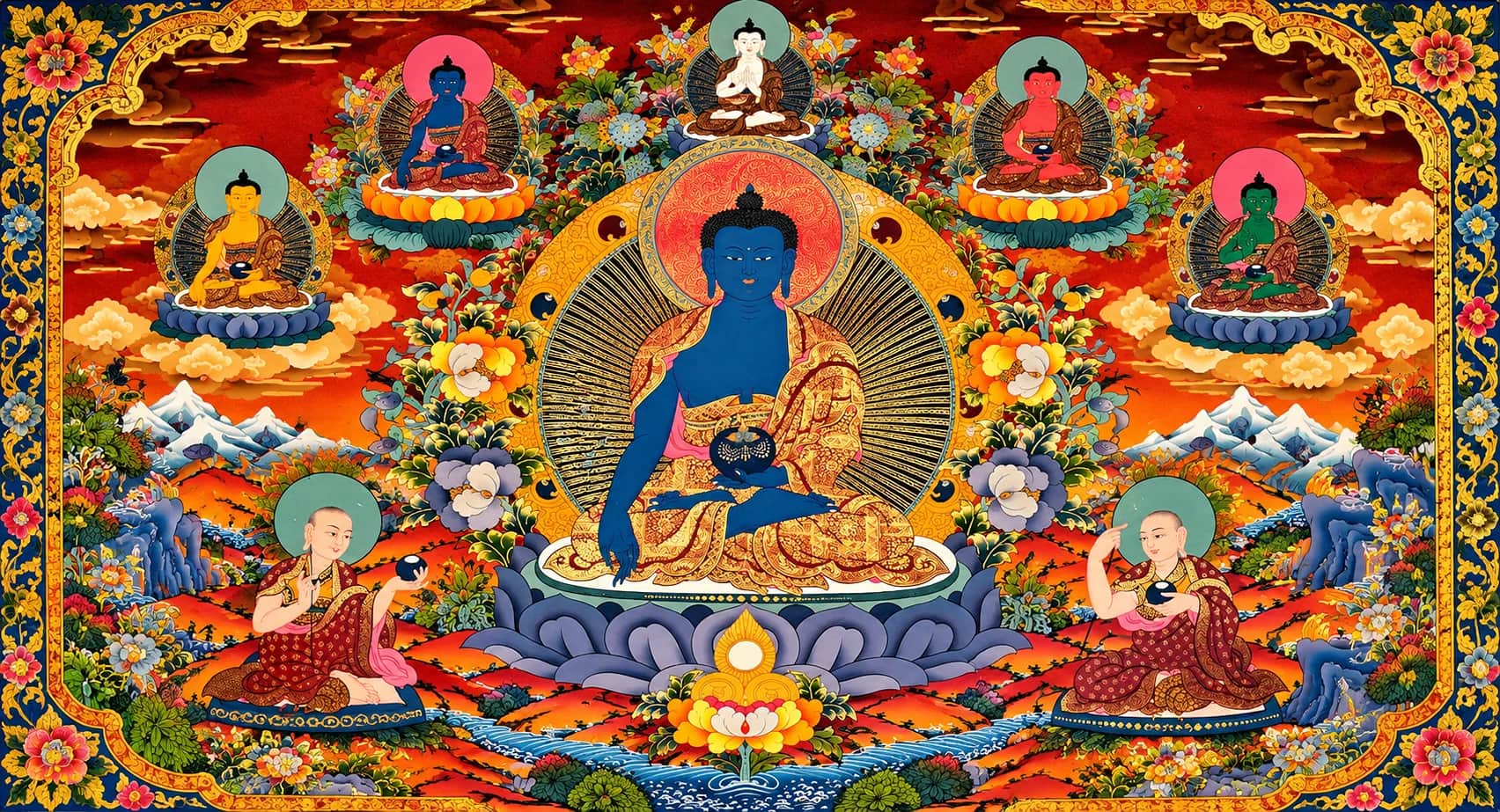
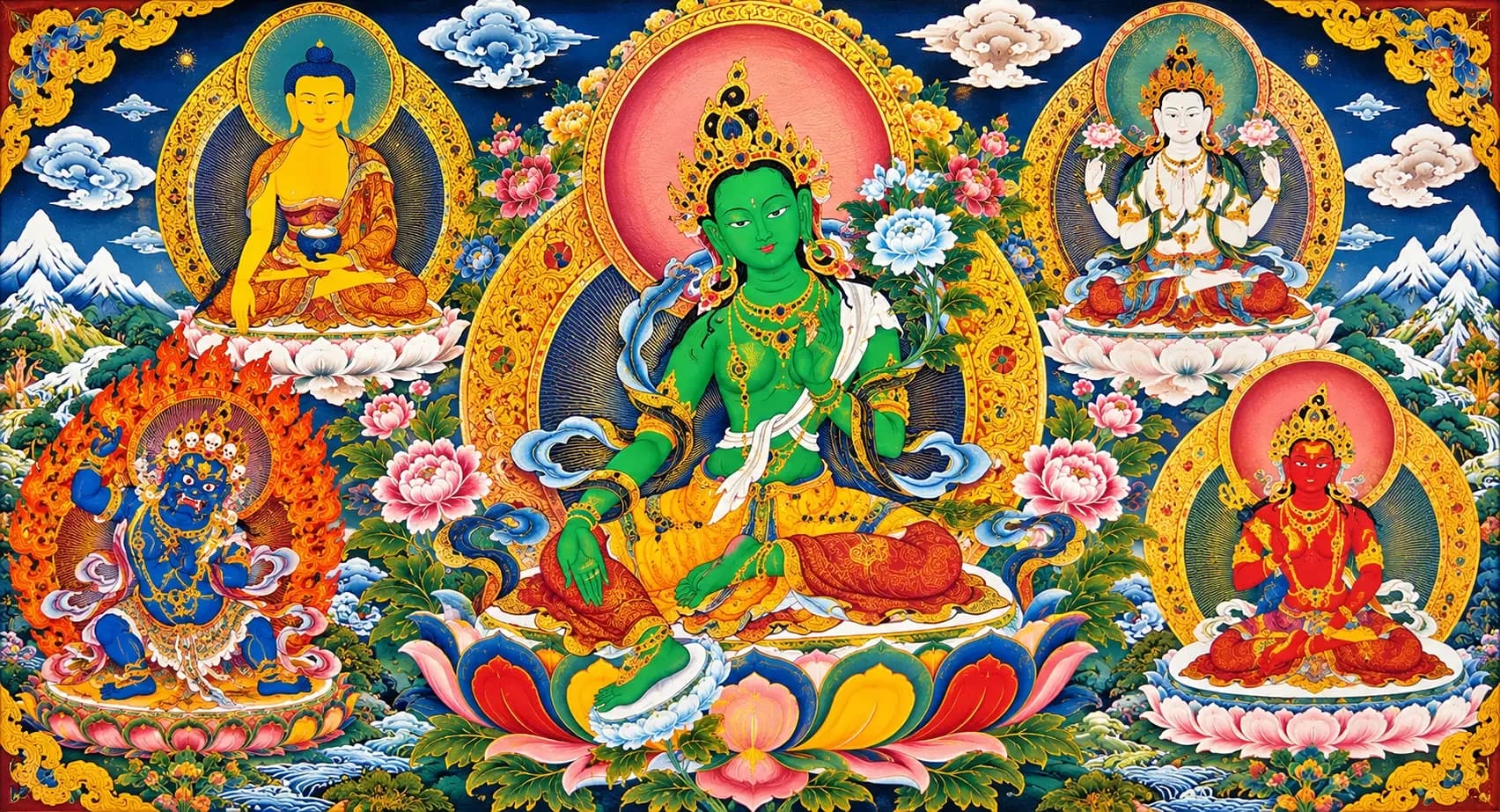
For example, Green Tara is commonly represented with a green body, while Medicine Buddha is often shown in blue. These colours are important identifying features of the figures.
Traditional Thangka artists also work with established iconographic guidelines. These guidelines shape the proportions, gestures, objects, and colours used to depict sacred subjects.
The result is an artwork in which visual design and symbolic meaning work together.
2. Meaning of Blue in Thangka Paintings
Blue is one of the most recognisable colours in Tibetan Buddhist art. It is often associated with wisdom, depth, vastness, and qualities that go beyond ordinary understanding.
Blue may appear in the bodies of particular Buddhas and deities, as well as in backgrounds and decorative elements.
Blue and Akshobhya Buddha
Akshobhya Buddha is traditionally associated with the colour blue. In the Five Buddha Families system, blue is connected with mirror-like wisdom and the transformation of anger or hatred.
This symbolism represents the idea of developing clear awareness rather than reacting through negative emotions.
Blue and Medicine Buddha
Medicine Buddha, also known as Bhaisajyaguru, is frequently depicted with a blue-coloured body. The colour helps identify him and is associated with his connection to healing and the removal of suffering.
When viewing a blue figure in a Thangka, it is useful to examine its posture, hand gestures, and symbolic objects before identifying the deity.
3. Meaning of White in Thangka Paintings
White is commonly associated with purity, peace, clarity, and purification in Buddhist art. It can represent peaceful qualities and the aspiration to overcome confusion and negative states of mind.
White is especially familiar in representations of White Tara.
White Tara
White Tara is a revered female figure in Tibetan Buddhist traditions. She is commonly associated with compassion, long life, healing, and peaceful qualities.
Her white body is one of the main visual features that help viewers recognise her. Many traditional representations also show additional eyes, symbolising awareness and compassion.
White and Peaceful Deities
White can also appear in other peaceful deity representations. Its meaning depends on the particular figure and iconographic tradition.
In a Thangka painting, white may be used for the body, clothing, lotus petals, clouds, or other decorative details. Each use contributes to the overall composition.
4. Meaning of Red in Thangka Paintings
Red is a powerful and visually striking colour in traditional Buddhist artwork. It can be associated with energy, compassion, magnetising activity and transformation.
In the Five Buddha Families system, red is traditionally associated with Amitabha Buddha and discriminating wisdom.
Red and Amitabha Buddha
Amitabha Buddha is commonly represented with a red body. The colour is associated with the Lotus Family and the wisdom that recognises distinctions without becoming controlled by attachment.
Amitabha is also strongly associated with the Pure Land tradition.
Red in Other Thangka Elements
Red may also appear in robes, decorative borders, backgrounds, halos, and the surrounding elements of sacred figures.
Its role can vary depending on the painting. In some contexts, red is associated with particular forms of spiritual activity, while in others it mainly contributes to the composition and visual balance.
5. Meaning of Green in Thangka Paintings
Green is commonly associated with activity, harmony, and compassionate action in Buddhist art. It is especially important in representations of Green Tara.
Green Tara
Green Tara is one of the best-known female figures in Tibetan Buddhist traditions. She is associated with compassionate activity and responding to difficulties.
She is commonly shown seated on a lotus throne, with one leg extended in certain representations to suggest readiness for action.
Her green body is an important identifying feature. Her hand gestures and lotus attributes provide additional clues about her identity.
Green and Amoghasiddhi Buddha
Within the Five Buddha Families, green is traditionally associated with Amoghasiddhi Buddha and all-accomplishing wisdom.
This association connects green with enlightened activity and the transformation of jealousy or envy.
Green may also appear in natural elements such as leaves, trees, and landscapes, adding depth and visual balance to the painting.
6. Meaning of Yellow and Gold in Thangka Paintings
Yellow and gold are important colours in traditional Himalayan Buddhist art. They can be associated with richness, generosity, stability, learning, and spiritual qualities.
Yellow and Ratnasambhava Buddha
In the Five Buddha Families system, yellow is associated with Ratnasambhava Buddha and the wisdom of equality.
This symbolism is connected with transforming pride and recognising the equal potential and dignity of beings.
Gold in Traditional Thangka Art
Gold is often used to highlight important details in a Thangka painting. It may appear in crowns, jewellery, halos, decorative patterns, sacred objects, and the ornaments of deities.
Gold creates a luminous effect and draws attention to particular features of the composition. It also demonstrates the artist's craftsmanship and the value traditionally placed on sacred artwork.
The use of gold varies from one painting to another depending on the artistic style, materials, and commission.
7. The Five Colours of the Buddha Families
A particularly important colour system in Vajrayana Buddhist traditions is the association of five colours with the Five Buddha Families.
These colours are often linked with five Buddhas, directions and forms of wisdom.
| Colour | Associated Buddha | Common symbolic association |
|---|---|---|
| Blue | Akshobhya | Mirror-like wisdom |
| White | Vairocana | Wisdom of the Dharmadhatu |
| Red | Amitabha | Discriminating wisdom |
| Green | Amoghasiddhi | All-accomplishing wisdom |
| Yellow | Ratnasambhava | Wisdom of equality |
These associations provide a useful way to understand colour symbolism in many Buddhist paintings. However, not every Thangka follows the same composition or uses all five colours in this arrangement.
The Five Buddha Families system is a spiritual and symbolic framework, not simply a decorative colour chart.
8. How Colours Work Together in a Thangka Painting
Colours rarely appear in isolation. Traditional artists combine them to create harmony, contrast and symbolic relationships throughout the composition.
For example, a painting may feature a central blue Buddha surrounded by figures wearing red, yellow or green garments. These colours can help distinguish the figures and organise the visual structure.
Artists also use lighter and darker shades to create depth, highlight important details and separate the central subject from the background.
Gold outlines and decorative elements may further emphasise sacred figures and important objects.
When studying a Thangka, observe how the colours interact rather than interpreting each shade separately. The overall arrangement often provides a clearer understanding of the painting's meaning.
9. Do Colours Have the Same Meaning in Every Thangka?
Not necessarily. Although traditional colour associations are widely recognised, their interpretation can change according to the subject and Buddhist tradition.
For example, blue may represent a particular Buddha, appear as part of a protective deity's body colour, or simply form part of the background.
Similarly, red can be associated with Amitabha in one composition and appear as a decorative or background colour in another.
To understand a colour accurately, consider:
- Which sacred figure is represented?
- What objects does the figure hold?
- Which hand gestures are shown?
- What other figures appear nearby?
- Does the painting follow a particular Buddhist tradition?
- Is the colour part of the figure itself or the surrounding design?
These questions help prevent oversimplified interpretations.
10. Traditional Pigments Used in Thangka Painting
The beauty of Thangka colours is also connected with the materials and techniques used by artists.
Traditional painters have used mineral and organic pigments to create different shades. These pigments were prepared and mixed with suitable binders before being applied to the painting surface.
Historically, certain blue and green pigments could be obtained from minerals, while other colours were produced from different natural sources. The availability of materials and the artist's workshop influenced the final palette.
Gold was also used for fine decorative work and to highlight important details.
Today, artists may use both traditional and modern materials depending on their training, methods, and artistic preferences.
To learn more about the techniques and materials involved, explore our guide on How a Thangka Is Painted.
11. How to Appreciate Colour Symbolism When Viewing a Thangka
You do not need to be an expert in Buddhist art to begin understanding colour symbolism. A few simple observations can make the experience more meaningful.
Start with the main figure: Identify the central Buddha, Bodhisattva, or deity before interpreting its colours.
Notice the body colour: Some figures have distinctive colours that help viewers recognise them.
Observe the symbolic objects: A lotus, vajra, medicine bowl or other object may provide additional context.
Look at the background: Notice whether it uses a contrasting colour, landscape or decorative pattern.
Compare the surrounding figures: Their colours may help explain their relationship to the central subject.
Consider the complete composition: Combine the visual clues instead of assuming that one colour has only one meaning.
For further reading, explore How to Read a Thangka Painting, where we explain the role of figures, symbols, and composition.
12. Why Colour Symbolism Matters in Traditional Himalayan Art
Colour symbolism is an important part of the artistic and cultural heritage preserved through Thangka paintings. It connects visual design with Buddhist teachings, traditional iconography and spiritual practices.
Each painting reflects the knowledge and care of its artist. The choice of colours, their placement, and their relationship with sacred figures all contribute to the meaning of the finished artwork.
Understanding these details also helps viewers appreciate Thangka paintings beyond their decorative appearance. They become easier to explore as visual expressions of philosophy, tradition and craftsmanship.
To discover more about the development of this art form, read our guide to the History of Thangka Painting.
Conclusion
The colours in Thangka paintings carry layers of artistic and symbolic meaning. Blue may be associated with wisdom and Akshobhya Buddha, white with peaceful qualities and White Tara, red with Amitabha and discriminating wisdom, green with compassionate activity and Amoghasiddhi, and yellow with Ratnasambhava and the wisdom of equality.
Gold adds another dimension through its luminous appearance and decorative importance.
Although these associations provide a helpful starting point, the meaning of a colour should always be understood in relation to the figure, tradition and complete composition.
By learning to recognise these visual details, viewers can develop a deeper appreciation for the symbolism, craftsmanship and cultural heritage of traditional Thangka paintings.
Discover the Beauty of Traditional Thangka Paintings
Explore Our CollectionFrequently asked questions
Answers to the questions readers ask most about this topic.
Colours in Thangka paintings communicate different spiritual qualities, symbolic ideas, and associations with Buddhist figures. Their meanings depend on the deity and artistic tradition.
Blue is commonly associated with wisdom and depth. It is also associated with Akshobhya Buddha and is used in representations of the Medicine Buddha.
White is commonly associated with purity, peace, clarity, and purification. It is an important colour in representations of White Tara.
Red is associated with Amitabha Buddha, discriminating wisdom, and particular forms of spiritual activity in Buddhist traditions.
Green is associated with compassionate activity and enlightened action. It is the distinctive body colour of Green Tara.
About the author: Nepathangka Editorial
Editorial Team
The Nepathangka editorial team writes about thangka painting, Buddhist iconography and Himalayan craft. We work with the painters and metalworkers in Nepal whose pieces we sell, and every guide is checked with the artisans before it goes live.