What is thangka? Symbol, Art and History
By Nepathangka Editorial, Editorial Team
, 8 min read
The word "Thangka," for the first time, they are often unsure how to pronounce it. Some say "thagha," while others say "thangka." The correct pronunciation is "THAHNG-kah." Despite the different pronunciations, they all refer to the same ancient Buddhist painting tradition that originated in northern Nepal and the Tibetan region.
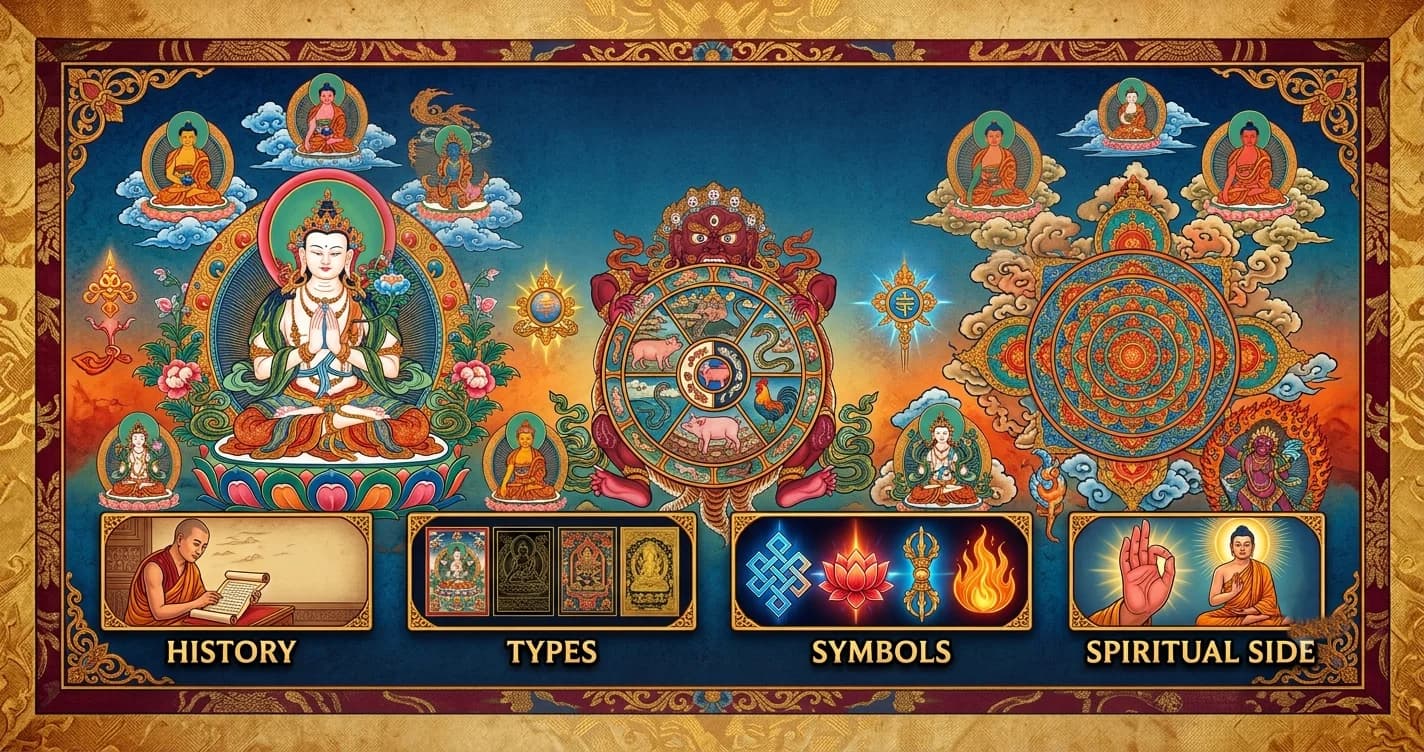
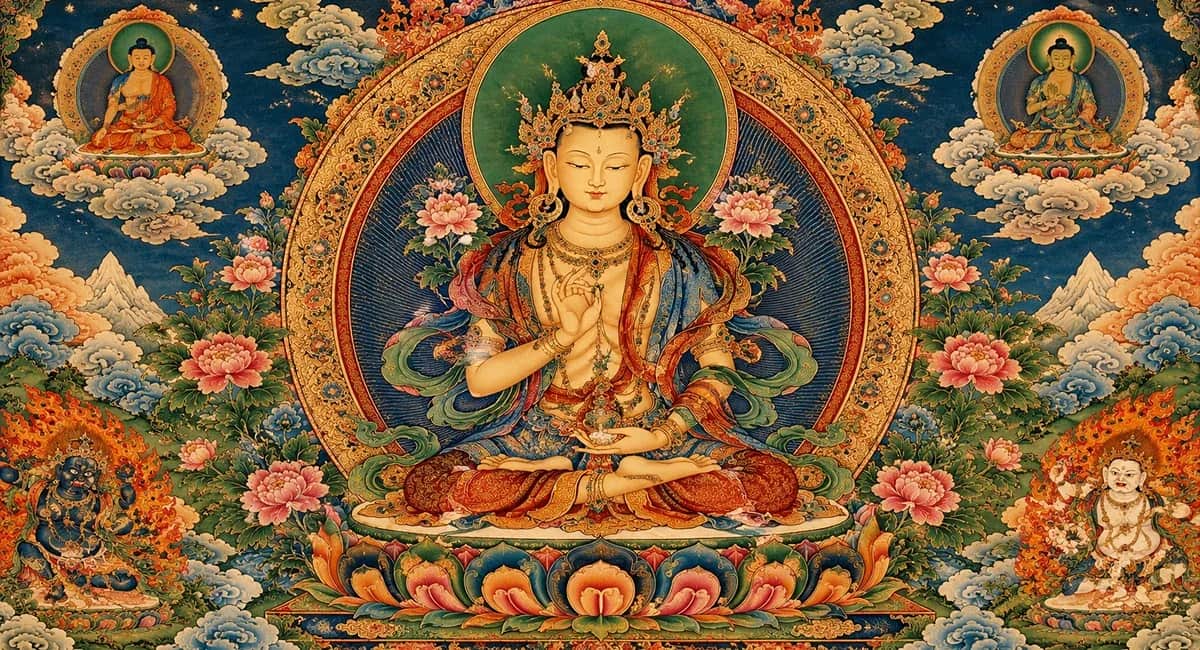
A thangka is a Tibetan Buddhist scroll painting, usually made on cotton or silk and framed in brocade so it can be rolled up and carried. For centuries, thangkas have been used as supports for meditation, as visual teaching tools, and as devotional offerings commissioned to create merit. Their imagery follows strict rules of proportion, color and symbolism, so every figure, gesture and background carries meaning. This guide explains what the word thangka means, how the tradition developed across Tibet, Nepal and the wider Himalayas, what thangkas depict, how they are made, and how to recognize and care for a genuine hand-painted piece.
What is a thangka?
A thangka (also spelled thanka, tangka or tanka) is a Tibetan Buddhist painting on cotton or silk, mounted in a textile border so it can be rolled up like a scroll. Most thangkas show a Buddha, a deity, a mandala or a teacher, and they are made to be used, not just admired. Practitioners meditate with them, teachers explain the Buddhist path with them, and families commission them to create merit or mark important life events.
Thangkas belong mainly to the Vajrayana Buddhist traditions of Tibet, and the art form is also practiced in Nepal, Bhutan, Ladakh, Sikkim and Mongolia.
What does the word "thangka" mean?
In Tibetan the word is written thang ka. It is usually explained as meaning something that is rolled out or unrolled, a reference to the scroll format. This fits how thangkas were used historically. A monk or wandering teacher could roll one up, carry it between monasteries and villages, and hang it wherever teaching or ritual took place. Unlike a wall mural, a thangka could travel.
A short history of thangka painting
Early roots in India, Nepal and Central Asia
Thangka painting grew out of older Buddhist painting traditions across Asia. When Buddhism spread into Tibet from the 7th century onward, it brought with it artistic influences from India's Pala-period monasteries, from the Newar artists of the Kathmandu Valley, and later from Chinese painting.
Painted Buddhist banners found in the Mogao caves at Dunhuang show that portable religious paintings were in use along the Silk Road well before the classic Tibetan styles took shape. The earliest surviving thangkas in the recognizable Tibetan form date to around the 11th and 12th centuries, and many of them show a strong Newar and Indian character: saturated reds, tight compositions and figures framed by ornate arches.
Newar painters played an especially important role. For centuries, Tibetan monasteries invited artists from the Kathmandu Valley, and their style shaped Tibetan painting deeply.
Tibetan painting schools
From the 15th century, distinctly Tibetan schools developed. Three are especially well known:
| School | Associated with | Recognizable features |
|---|---|---|
| Menri | Menla Döndrup (15th century) | Balanced compositions, bright colors, a central figure surrounded by landscape; became highly influential in central Tibet |
| Khyenri | Khyentse Chenmo (15th century) | Dynamic, often wrathful figures, strong color contrast, dense detail |
| Karma Gadri | Associated with the Karma Kagyu tradition (16th century onward) | Open space, soft blues and greens, Chinese-influenced landscapes with clouds, rocks and water |
These schools were not rigid categories. Painters trained in one tradition often borrowed from others, and regional styles in Bhutan, Ladakh and Mongolia developed their own character over time.
What is a thangka used for?
A thangka is primarily a religious object. Its artistic beauty matters, but it serves a purpose beyond decoration.
A support for meditation
In Vajrayana practice, a meditator often visualizes a deity in precise detail: its color, posture, hand gestures, ornaments and surroundings. A thangka gives the practitioner a correct reference image. Because the painting follows fixed iconographic rules, the figure a student studies on the wall matches what the texts describe.
A teaching tool
Many thangkas work as visual lessons. The Wheel of Life (Bhavachakra) maps the cycle of rebirth, showing the realms of existence, the twelve links of dependent origination, and the three poisons of greed, hatred and ignorance at the center. Lineage trees show how teachings passed from teacher to student. Paintings of the Buddha's life tell his story scene by scene.
One remarkable example is the set of Tibetan medical thangkas commissioned in the late 17th century by Desi Sangye Gyatso, regent of the 5th Dalai Lama. These paintings illustrate the Four Tantras, the core text of Tibetan medicine, covering anatomy, diagnosis, medicinal plants and treatment.
An act of merit
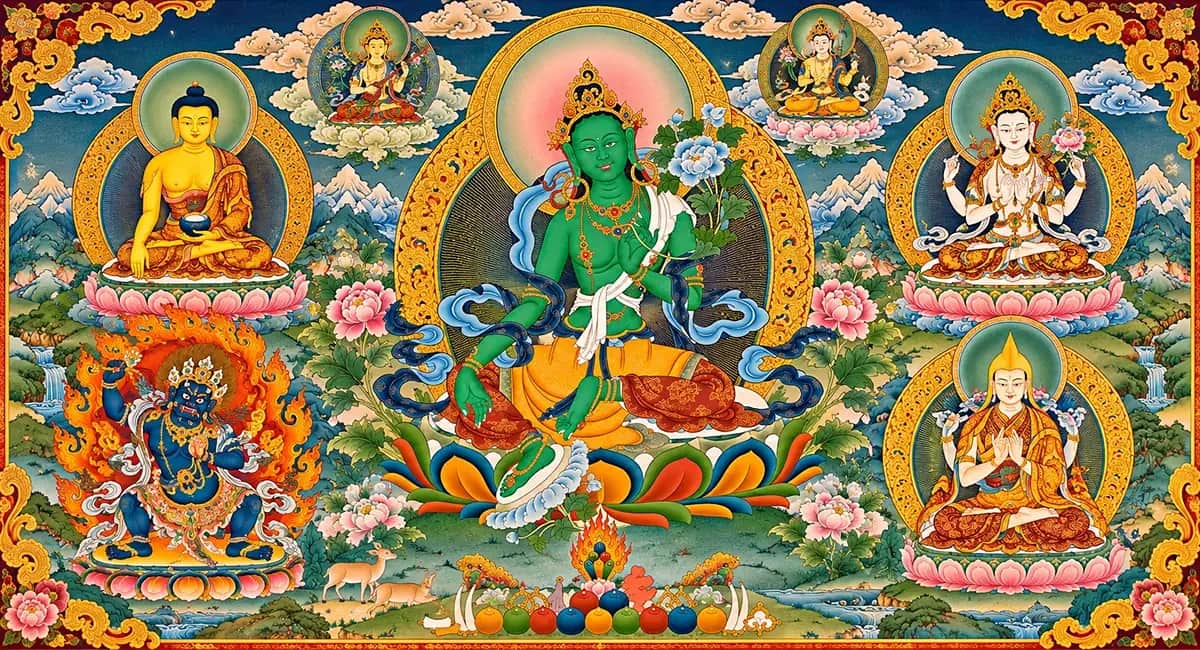
Commissioning a thangka is traditionally considered a meritorious act. A family might sponsor a painting to support someone who is ill, to honor a relative who has died, to mark an important life event, or as a devotional offering. The choice of deity usually connects to the purpose: the Medicine Buddha for healing, Amitayus for long life, Green Tara for protection from fear and obstacles.
Festivals and public display
Some thangkas are enormous. Monasteries unroll giant appliqué thangkas on hillsides or purpose-built walls during festivals, where they may be displayed for only a few hours. Drepung Monastery near Lhasa is famous for this during the Shoton festival, and in Bhutan, giant thangkas called thongdrel are displayed at the end of tsechu festivals. Seeing one is considered a blessing in itself.
What do thangkas depict?
Most thangkas fall into a handful of subject groups:
- Buddhas , such as Shakyamuni (the historical Buddha), Amitabha and the Medicine Buddha.
- Bodhisattvas , including Avalokiteshvara (compassion), Manjushri (wisdom) and Tara in her various forms.
- Meditational and protector deities , some peaceful and some wrathful. Wrathful figures surrounded by flames can look frightening, but they represent the forceful energy that cuts through ignorance and obstacles, not evil.
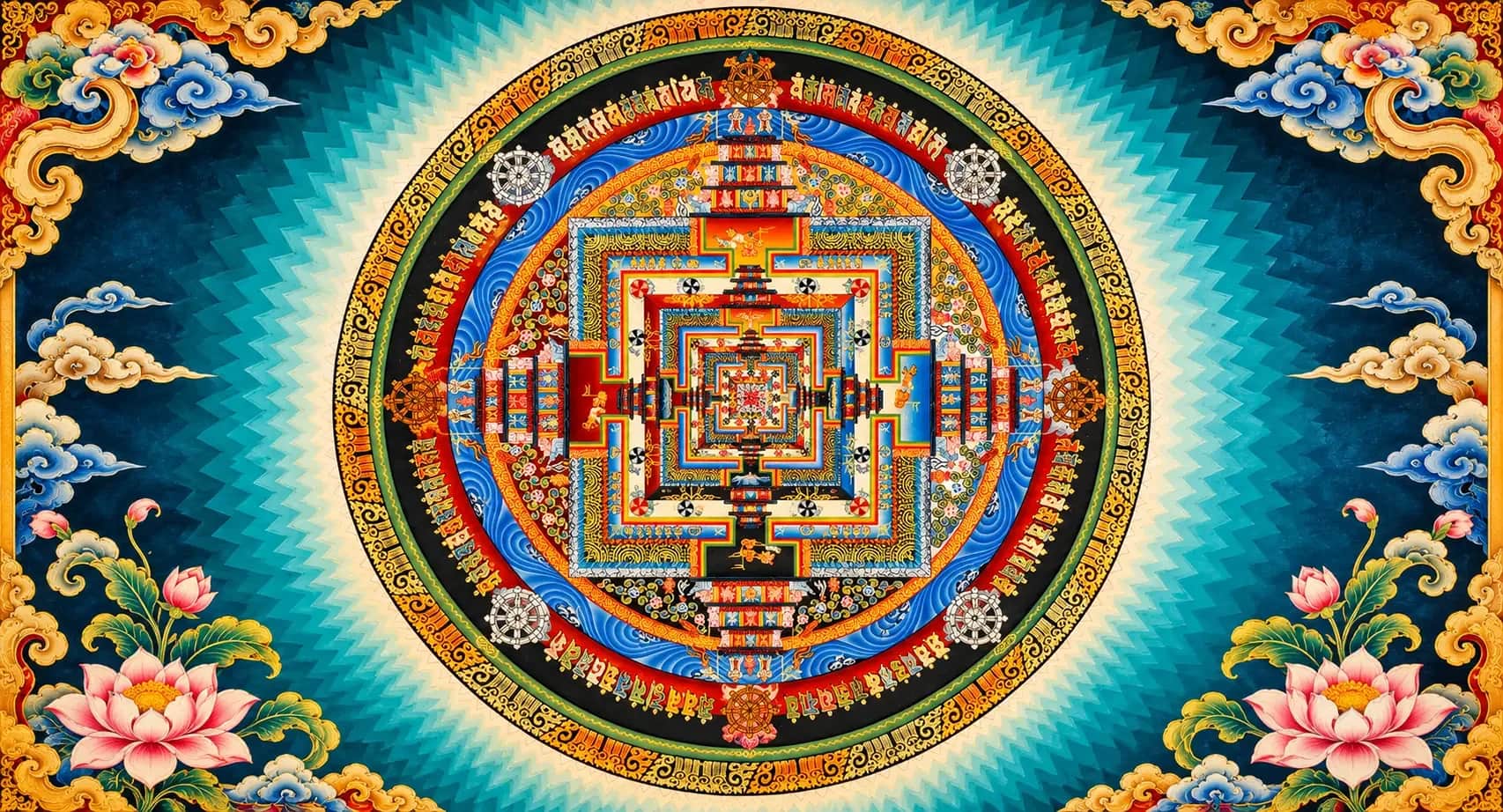
- Mandalas , diagrams of an enlightened being's pure realm, seen from above.
- Teachers and lineage figures , such as Padmasambhava, Milarepa or the founders of particular schools.
- Narrative and teaching subjects , like the Wheel of Life, the life of the Buddha, or medical and astrological charts.
Details carry meaning. Hand gestures (mudras), objects held, body color, posture, and the animals or thrones beneath a figure all help identify who is shown and what quality they embody.
Types of thangka Art
Thangka comes in several distinct varieties. Each type carries its own purpose, technique, color character, and visual identity. Every style tells a different kind of story.
Painted Thangka (Tsem thangka)
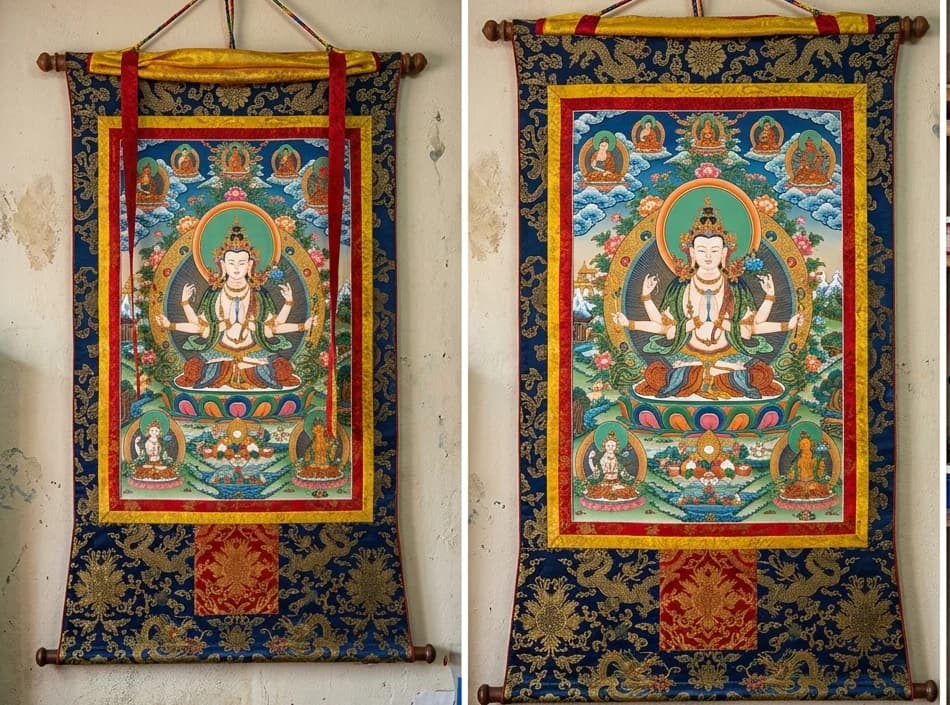
This is the most common thangka art. Artists paint outline figures, landscapes, clouds, temples, and symbols by hand on prepared cotton or silk fabric. A painted thangka is often dedicated to Buddha, Tara, Avalokiteshvara, Padmasambhava, or a mandala. The colors for painting come from natural stone pigments ground from mountain rocks, mixed with glue water, and applied in careful sequence from background washes through to fine detail and gold finishing.
Applique Thangka (Go-Tang)
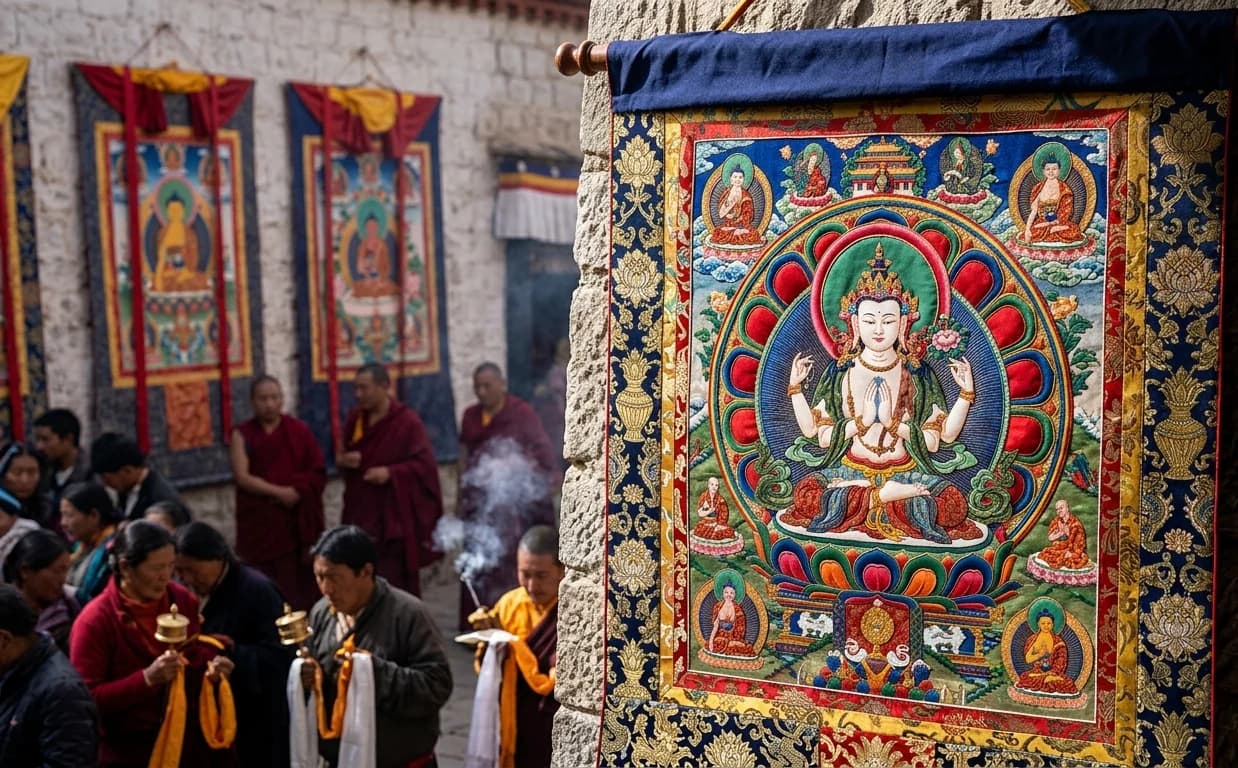
Artists construct applique thangkas from cut pieces of fabric. Artists sew and stitch layers of silk, brocade, and embroidery together to form sacred figures and symbols. Communities frequently display this style during large thangka festivals and ceremonial gatherings. The physical texture and layered depth of an applique thangka give it a visual power that differs entirely from a painted work.
Black thangka (Nagthang)
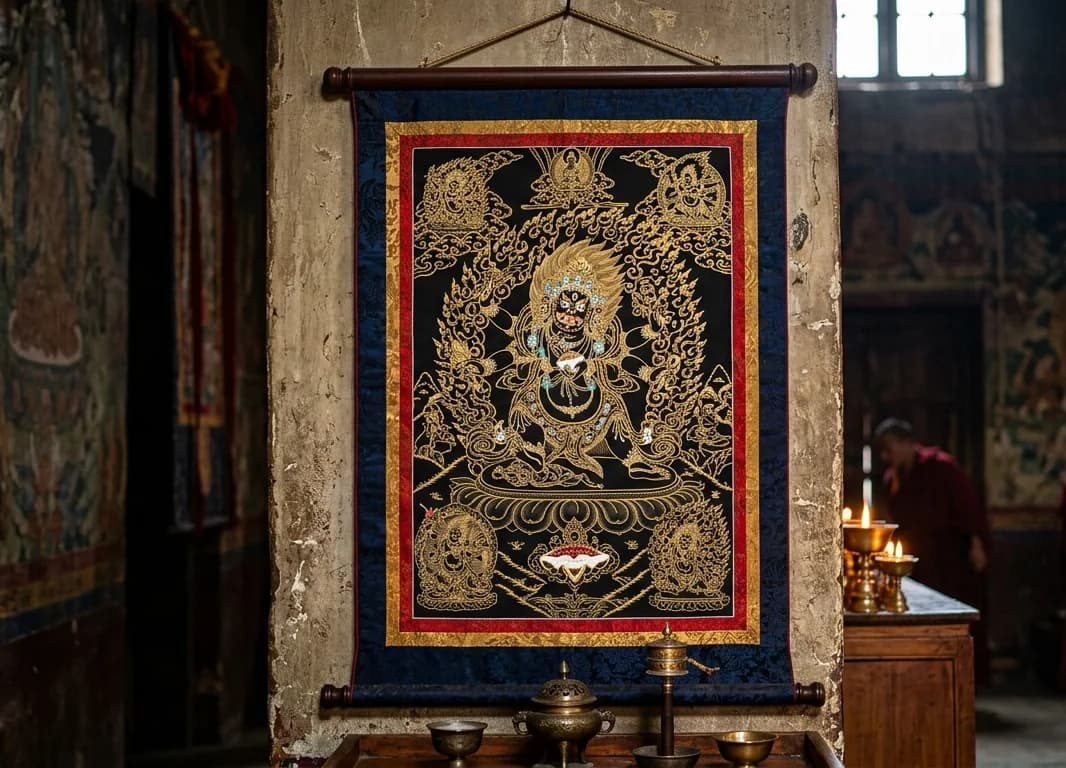
This style uses a dark or black background with fine gold lines or light-colored accents painted over it. The effect is bold, serious, and commanding. It is the common form that artists choose to depict wrathful protectors or those associated with strong rituals. The contrast between the dark background and the bright gold highlights the intensity of the image.
Gold Thangka (Serthang)
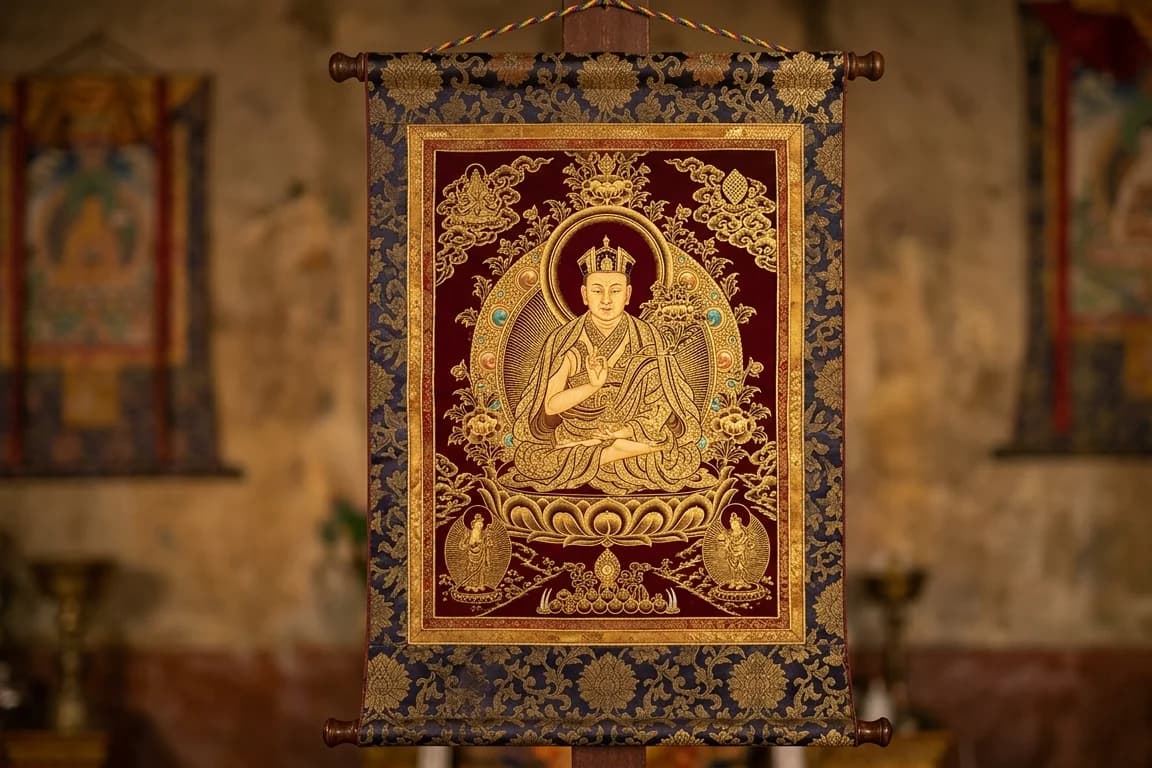
It uses a red, dark, or deep-colored background and paints the figures primarily in gold. The result looks rich, sacred, and full of inner light. Many collectors and spiritual practitioners admire this style for its beauty and for the sense of illuminated presence it brings to the figure depicted. Teachers often commission gold thangkas for the highest level spiritual teachings.
Embroider Thangka
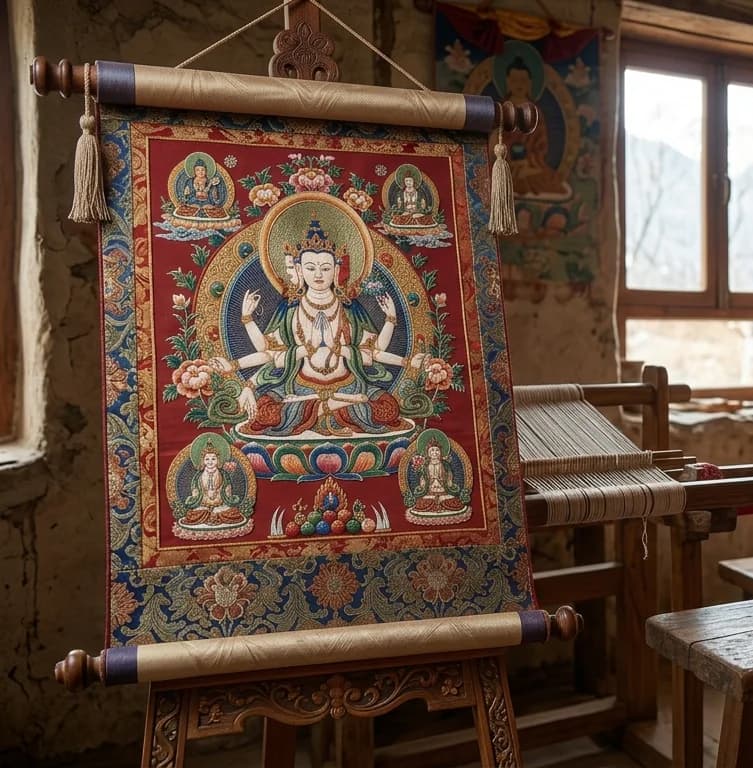
Instead of paint, artisans stitch embroidered thangkas entirely by hand using fine thread on silk. This style demands extraordinary patience and precision. It demonstrates the full depth of craftsmanship that authentic thangka art requires across all its forms. The finished work carries a texture and warmth that painted thangkas cannot replicate.
The Spiritual Side of thangka
People use a thangka with purpose; religious people use it to focus, to offer devotion and to meditate. A monk sits in front of a thangka and uses the image to deepen concentration. A family keeps one at home as a constant reminder of peace and compassion. A teacher uses one to explain spiritual levels and values to students.
- It is for meditation and prayer
- It has deep religious meaning.
- It teaches values like peace, compassion, and wisdom.
- thangka to bring a calm and positive feeling into their space.
- Important part of Buddhist devotion and culture.
Many artists approach the work of painting itself as a spiritual discipline. Before an artist paints, they have to be in meditation because the artist has to concentrate the mind. For every hour of painting, the painter takes 10 to 15 minutes to meditate, because it is very stressful. This regular meditation keeps the artist's mind stable and clear throughout the process. A thangka painted with a distracted or agitated mind does not carry the same quality as one produced in a state of calm concentration. Many traditional teachers regard the mental state of the artist as just as important as technical skill.
Symbols of thangka
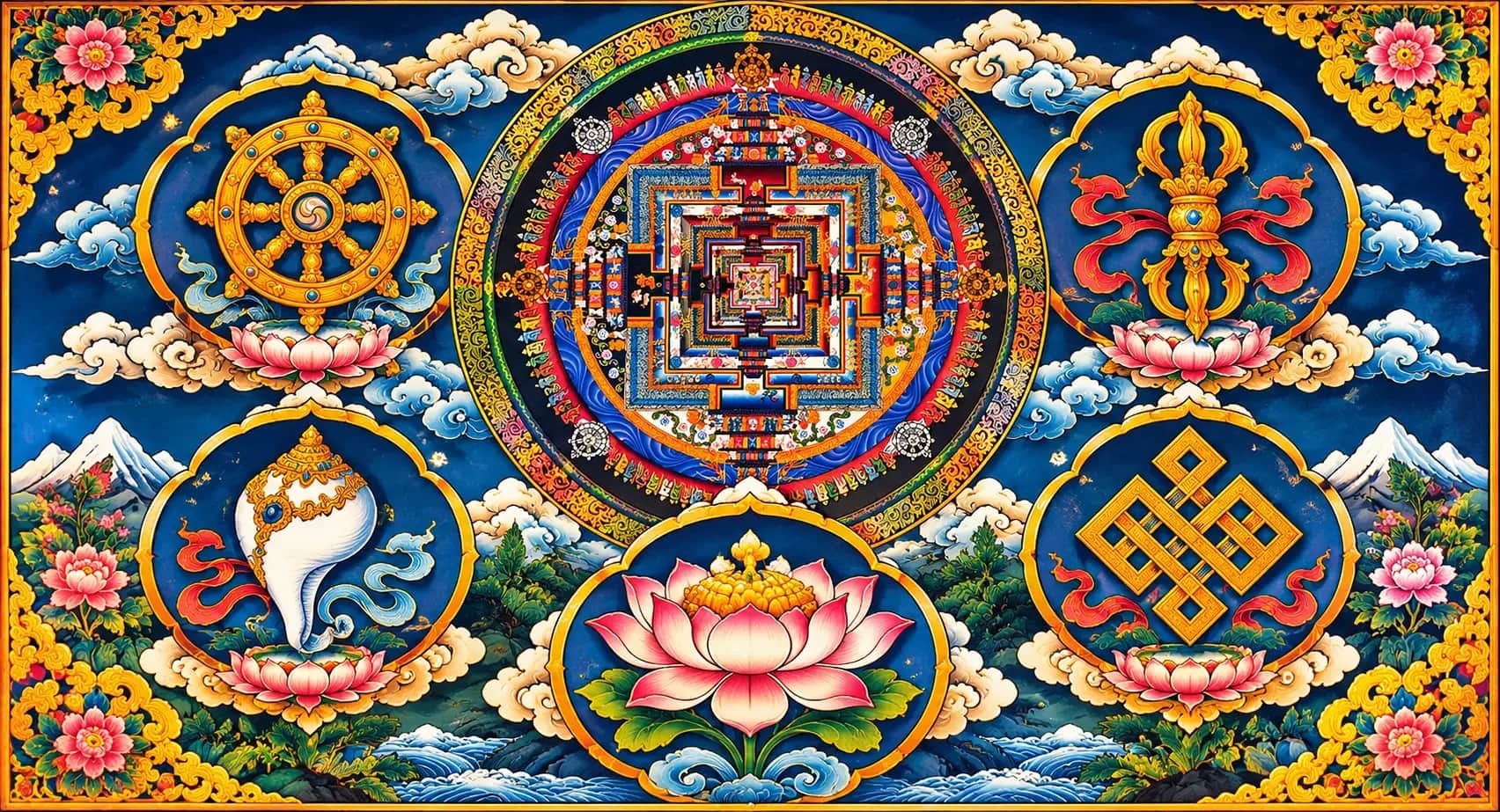
Every drop of ink in thangka has its own meaning. Even a single dot is not accidental in thangka. Every small sign, image, line, architecture, and outline has its own meaning in thangka, so every thangka costs more and has more symbolic and spiritual value than other arts.
- The endless knot shows that everything in life is connected.
- Flames represent change and the burning away of ignorance.
- A raised hand can mean protection, while a lowered hand can mean blessing.
- Blue stands for wisdom and white for peace.
- Red for compassion, and gold for enlightenment.
- The pig represents ignorance
- The snake represents anger.
- The rooster represents greed.
One of the most popular thangka subjects is the Wheel of Life. In the center of the Wheel of Life, three animals are depicted: the pig, the snake, and the rooster. The entire Wheel of Life is held by the God of Death himself, Yama, while the Buddha stands outside the Wheel and points to freedom, peace, and nirvana. This is what makes authenticthangka art so special.
Conclusion
A thankga, thangka, or thangha is not simply a painting. It is sacred art, cultural memory, symbolic teaching, and spiritual practice in one form. Its history reflects the deep roots of the Buddhist tradition of the Himalayas. Its symbols carry layered meaning that rewards careful study. Its colours speak a precise visual language developed over centuries. Its spiritual side gives it a life that goes far beyond decoration.
Frequently asked questions
Answers to the questions readers ask most about this topic.
Yes, all three spellings refer to paintings that are painted on flat cloth.
Artists use cotton or silk fabric, natural stone pigments ground from mountain rocks, fine rabbit-hair brushes, 24-karat gold for finishing highlights, and silk brocade for the mounting border.
Yes, a hand-painted thangka with strong craftsmanship, correct iconography, and cultural authenticity makes a worthwhile collectible.
Authentic thangkas show neat lines, symbolic accuracy, and the unmistakable quality of handmade work.
The price depends on the size and complexity of the design. In the Nepali market, prices range from under $100 to thousands of dollars.
About the author: Nepathangka Editorial
Editorial Team
The Nepathangka editorial team writes about thangka painting, Buddhist iconography and Himalayan craft. We work with the painters and metalworkers in Nepal whose pieces we sell, and every guide is checked with the artisans before it goes live.