The Meaning of Symbols in Tibetan Buddhist Art: A Visual Guide
By Nepathangka Editorial, Editorial Team
, 9 min read
Explore the meaning of important symbols in Tibetan Buddhist art. Learn how the lotus, vajra, Dharma wheel, conch, and other sacred motifs express Buddhist teachings and spiritual ideas.
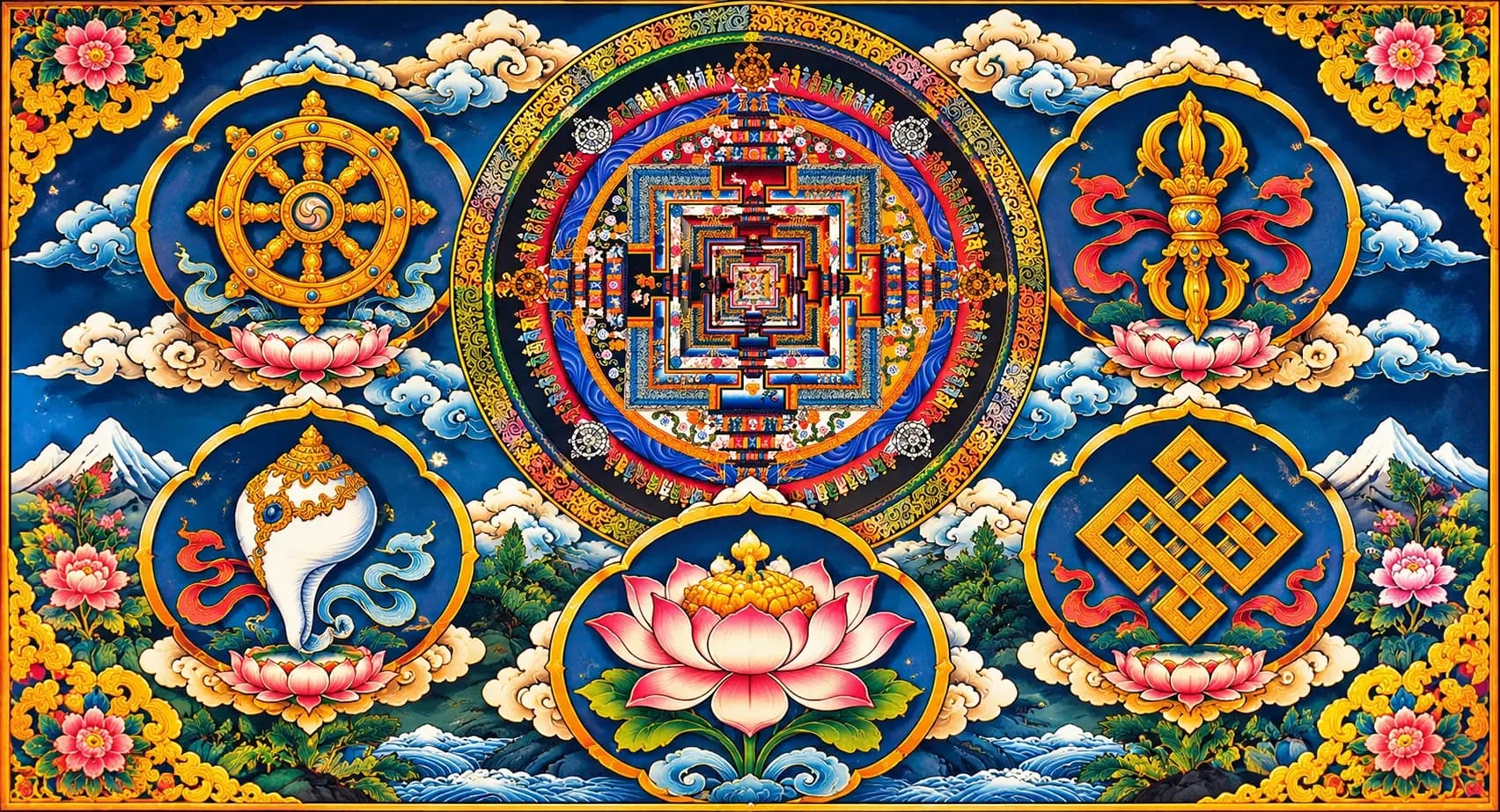
Tibetan Buddhist art uses a rich visual language to communicate spiritual teachings, philosophical ideas, and cultural traditions. From the lotus flower and Dharma wheel to the vajra and eight auspicious symbols, each design carries layers of meaning. This guide explores the most recognisable symbols found in traditional Thangka paintings and explains how to understand them in their artistic and cultural context.
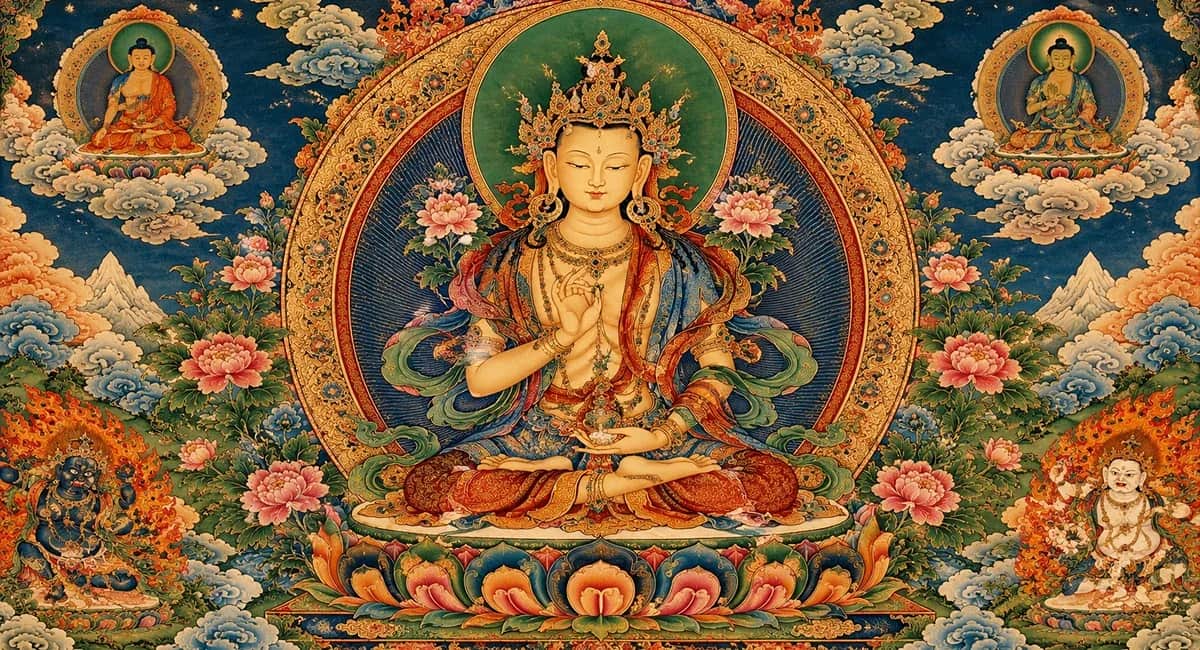
Tibetan Buddhist art is known for its detailed compositions, vibrant colours, sacred figures, and carefully arranged decorative elements. Traditional Thangka paintings are more than beautiful works of art. They use a visual language to communicate Buddhist teachings, spiritual qualities, and ideas about the path to enlightenment. Every figure, gesture, object, and pattern can contribute to the meaning of a painting.
Understanding the symbols in Tibetan Buddhist art helps viewers appreciate these paintings beyond their appearance. A lotus flower, for example, can represent purity and spiritual development, while a Dharma wheel refers to the Buddha's teachings. Other symbols communicate protection, wisdom, compassion, and the relationship between different aspects of Buddhist philosophy.
This visual guide introduces some of the most important symbols found in Tibetan Buddhist art and explains how they are commonly understood.
1. Why Are Symbols Important in Tibetan Buddhist Art?
Symbols make complex religious and philosophical ideas easier to recognise visually. In traditional Buddhist paintings, an object held by a deity, a flower beneath a figure, or a design surrounding a central image may communicate a specific teaching or quality.
Artists use established visual conventions so that knowledgeable viewers can identify important figures and themes. These conventions are part of Buddhist iconography, the study of the forms, attributes, gestures, and arrangements used in religious images.
Symbols also help create a connection between the artwork and the viewer. They can encourage reflection on qualities such as patience, wisdom, compassion and awareness. Their precise interpretation may depend on the deity, Buddhist tradition, painting style, and surrounding composition.
2. The Lotus Flower: Purity and Spiritual Growth
The lotus is one of the most recognisable symbols in Buddhist art. It grows from muddy water but opens into a beautiful flower above the surface. This natural process is commonly used to express purity, spiritual development, and the possibility of awakening.
In Thangka paintings, Buddhas and Bodhisattvas are frequently shown seated or standing on lotus thrones. The flower provides a sacred visual foundation and distinguishes the enlightened figure from the ordinary world.
The lotus may also appear in the hands of particular deities. Its colour and arrangement can offer additional clues about the figure or the painting's subject. However, the meaning should always be considered in relation to the complete image.
3. The Dharma Wheel: The Buddha's Teachings
The Dharma wheel, known in Sanskrit as the Dharmachakra, represents the Buddha's teachings and the path of Buddhist practice. It is commonly shown with eight spokes, which are associated with the Noble Eightfold Path.
The eightfold path describes practices that support ethical conduct, mental discipline and wisdom. These include right understanding, intention, speech, action, livelihood, effort, mindfulness and concentration.
In Buddhist artwork, the wheel may appear near a Buddha figure, on a throne or as part of an auspicious decorative arrangement. It reminds viewers of the importance of learning, practising and sharing the Dharma.
4. The Vajra or Dorje: Strength and Indestructible Wisdom
The vajra, called a dorje in Tibetan, is a distinctive ritual object frequently represented in Vajrayana Buddhist art. It often has a symmetrical shape with a central grip and pronged ends.
The vajra is associated with indestructibility, spiritual power, and the unchanging nature of ultimate reality. It is also connected with the quality of enlightened wisdom.
In many ritual contexts, the vajra is paired with a bell. Together, these objects express the relationship between compassion or skilful means and wisdom. Their symbolism is especially important in Vajrayana practices.
When examining a Thangka, look carefully at the objects held by the central figure. A vajra can be an important clue for identifying the deity and understanding the subject of the painting.
5. The Conch Shell: The Sound of the Dharma
The right-turning conch shell is one of the eight auspicious symbols in Tibetan Buddhist tradition. Its sound is associated with the proclamation of the Dharma and the awakening of beings from ignorance.
In paintings and ritual objects, the conch is often decorated with elaborate details. Its spiral form makes it easy to recognise, although the direction of the spiral is an important identifying feature in traditional depictions.
The conch communicates the idea that Buddhist teachings can reach many people, just as a powerful sound travels across a wide area.
6. The Eight Auspicious Symbols
The Eight Auspicious Symbols, known as Ashtamangala in Sanskrit, form an important group in Tibetan Buddhist visual culture. They appear in paintings, temple decoration, textiles, ceremonial objects, and other forms of traditional art.
The commonly recognised group includes:
The Parasol
The parasol represents protection from suffering, harmful influences, and obstacles. Its canopy can also suggest dignity and spiritual shelter.
The Golden Fish
The pair of golden fish is associated with freedom, happiness and liberation. Their movement through water provides a visual image of ease and freedom.
The Treasure Vase
The treasure vase represents abundance, prosperity, long life and the fulfilment of positive qualities. It is often shown as a decorated vessel filled with precious contents.
The Lotus
The lotus represents purity, spiritual growth and awakening. Its ability to bloom above muddy water makes it a powerful image of transformation.
The Right-Turning Conch
The conch represents the far-reaching sound of Buddhist teachings. It is associated with the spreading of the Dharma and the awakening of wisdom.
The Endless Knot
The endless knot represents interconnectedness and the relationship between wisdom and compassion. Its continuous design has no obvious beginning or end.
The Victory Banner
The victory banner symbolises the triumph of Buddhist teachings over ignorance and obstacles. It is often depicted as a decorated vertical banner.
The Dharma Wheel
The Dharma wheel represents the Buddha's teachings and the path towards spiritual understanding. Its spokes are commonly associated with the Noble Eightfold Path.
These eight symbols are frequently displayed together, but individual symbols can also appear separately. Their exact visual arrangement may vary across regions and artistic traditions.
7. The Endless Knot: Interconnection and Wisdom
The endless knot is a complex decorative design made from interwoven lines. It has no clear beginning or ending, making it a visual representation of continuity and interconnectedness.
In Tibetan Buddhist art, it is commonly associated with the relationship between wisdom and compassion. It can also encourage reflection on how actions, experiences, and relationships influence one another.
The symbol appears on temple decorations, textiles, ceremonial objects, and Thangka paintings. Its repeating pattern makes it both visually attractive and philosophically meaningful.
8. The Bell: Wisdom and Awareness
The ritual bell, known as a ghanta in Sanskrit, is an important object in Vajrayana Buddhist practice. It is frequently paired with the vajra.
The bell is traditionally associated with wisdom, while the vajra represents skilful means or compassion in this symbolic pairing. Together, they express qualities that are understood as complementary on the path to enlightenment.
In Buddhist paintings, the bell may be held by a deity or represented as part of a ritual arrangement. Its presence can help viewers understand the spiritual context of the image.
9. The Three Jewels: Buddha, Dharma and Sangha
The Three Jewels are central to Buddhist tradition. They refer to the Buddha, the Dharma, and the Sangha.
- Buddha: The awakened teacher and the example of enlightenment.
- Dharma: The teachings and principles that guide Buddhist practice.
- Sangha: The spiritual community that follows and preserves those teachings.
These three refuges are sometimes represented through symbolic arrangements, including jewel-like forms. They express the foundations of Buddhist faith and practice.
10. Mandalas: A Symbolic Representation of Sacred Space
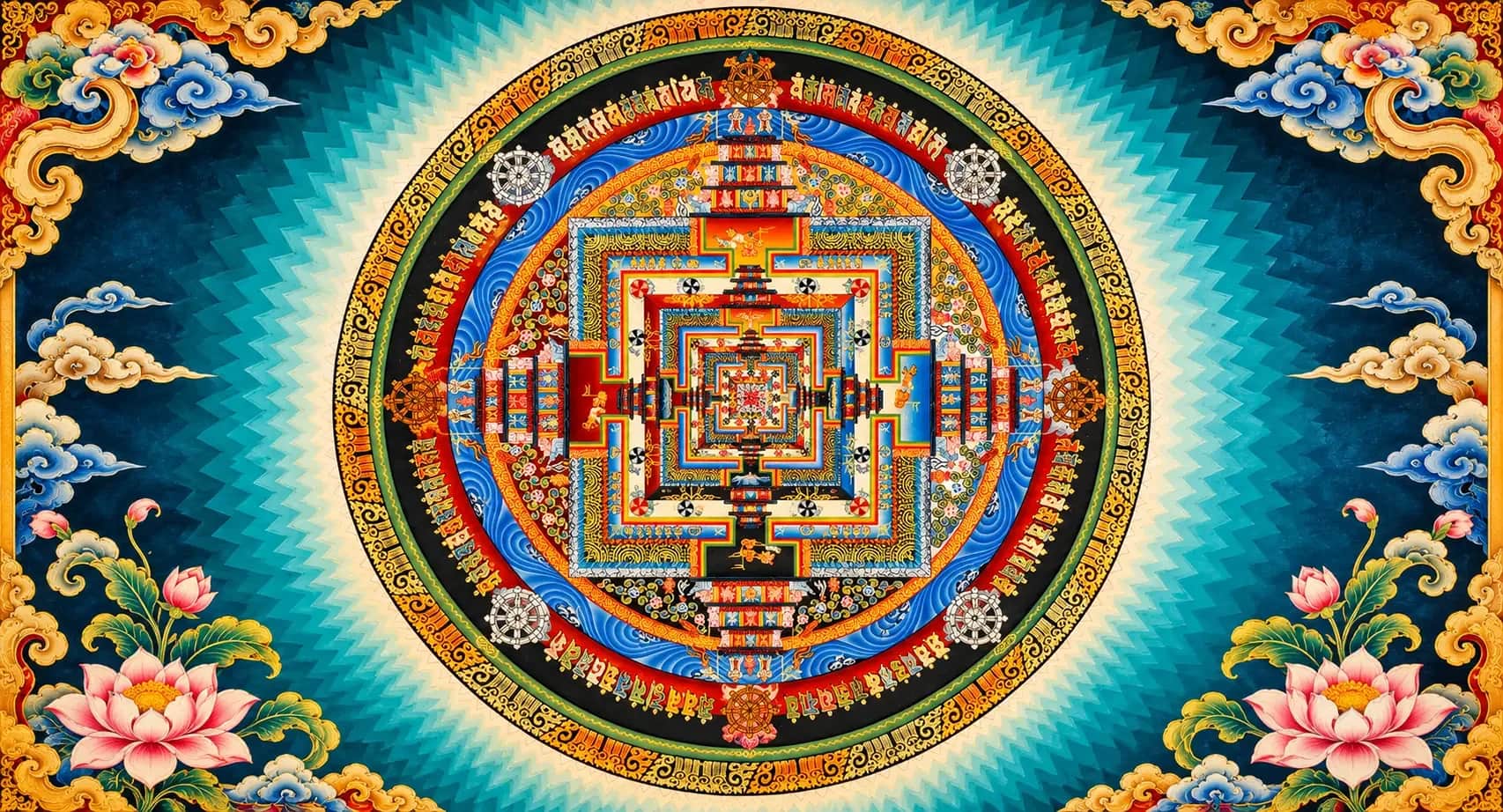
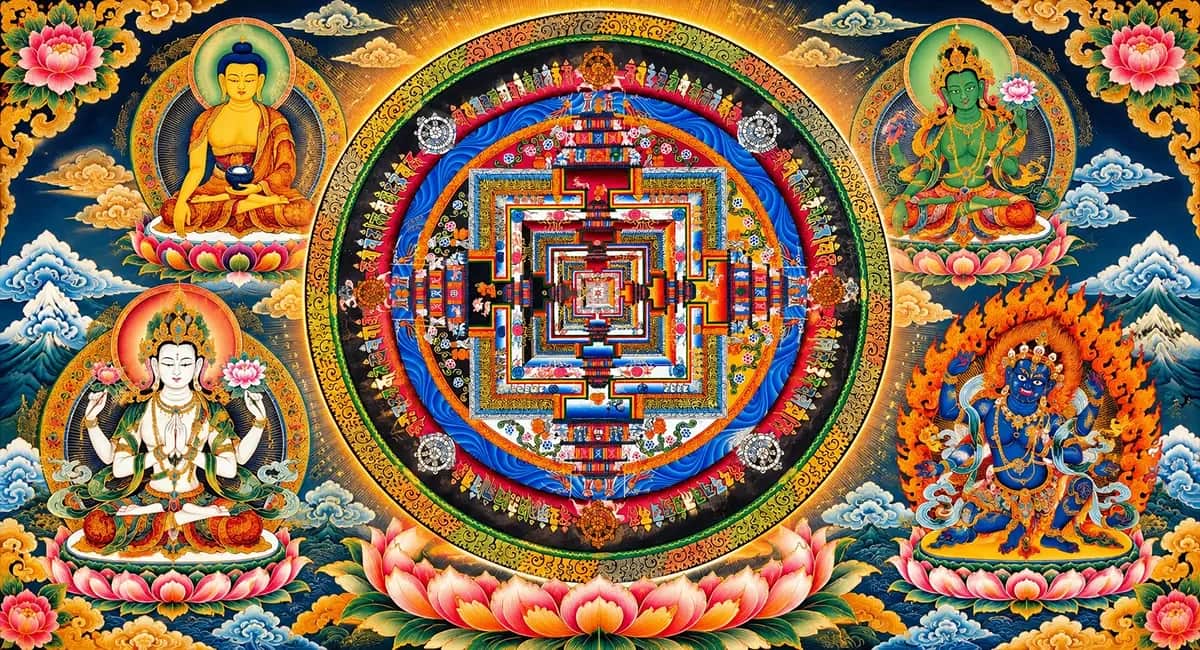
A mandala is a carefully organised geometric composition used in several Buddhist traditions, particularly in Vajrayana contexts. It often contains a central figure or palace surrounded by symmetrical structures, gates, circles, and symbolic elements.
Mandalas can represent a sacred environment and provide a visual structure for meditation and ritual practice. Their detailed arrangements are not simply decorative patterns; they follow established traditions and can carry complex meanings.
When viewing a mandala in a Thangka, notice its central point, surrounding circles, directional gates, and repeated geometric patterns. Each part contributes to the overall composition.
11. How to Identify Symbols in a Thangka Painting
Understanding Buddhist symbols becomes easier when you examine a painting systematically.
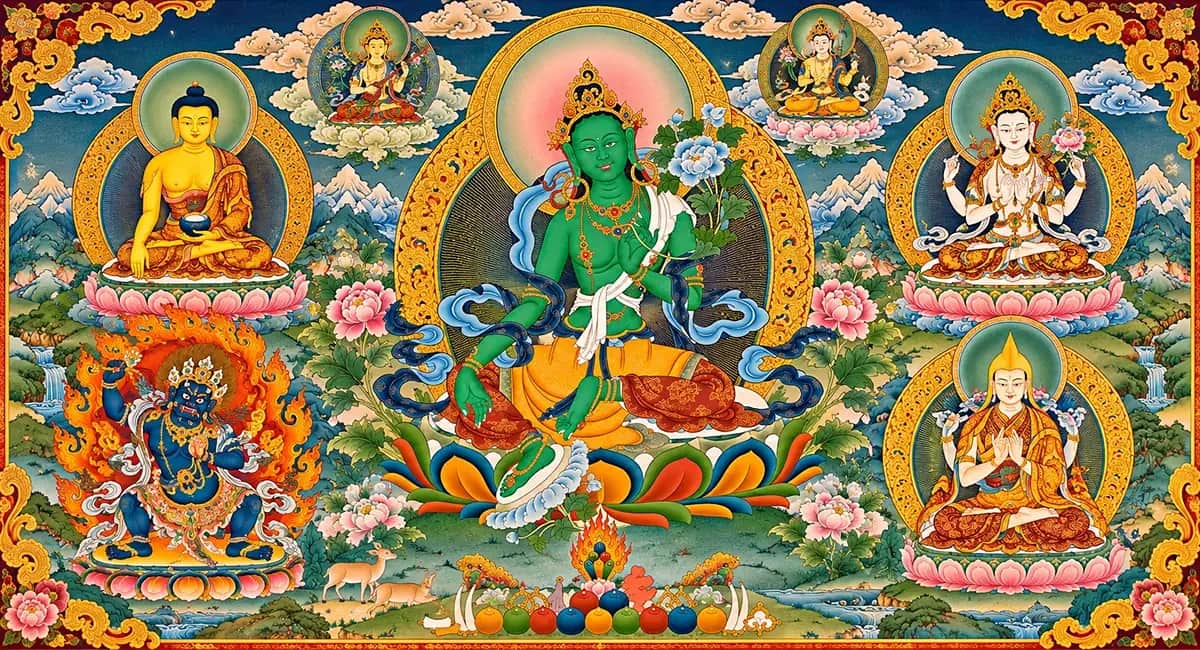
Start with the central figure. Identify whether the main subject is a Buddha, Bodhisattva, teacher, or another deity. Then observe the objects held in the hands, the posture, the hand gestures, and the throne or lotus seat.
Next, examine the surrounding figures and decorative elements. Look for familiar objects such as the lotus, vajra, bell, conch, wheel, or treasure vase. Pay attention to repeated patterns and the placement of symbols within the composition.
For a more detailed explanation of visual interpretation, read our guide on how to read a Thangka painting.
You can also learn how traditional artists prepare and create these detailed paintings in our article about how a Thangka is painted.
12. The Role of Symbols in Traditional Thangka Painting
Symbols are closely connected with the artistic process of creating a Thangka. Traditional artists follow established proportions, iconographic guidelines, and painting techniques to represent sacred figures and their attributes.
The placement of a symbol is important. A lotus beneath a deity may function as a throne, while a lotus held in the hand may identify a particular attribute or spiritual quality. Similarly, a wheel may appear as an independent auspicious emblem or as part of a larger religious composition.
To understand how these artistic traditions developed, explore our article on the history of Thangka painting.
13. Why Context Matters When Understanding Buddhist Symbols
Although many symbols have widely recognised meanings, their interpretation should not be separated from the complete artwork. The same object may serve different purposes depending on the deity, ritual tradition or artistic setting.
For example, the lotus can represent purity and awakening, but its colour, position and relationship with a particular figure may add further meaning. A vajra may be a ritual implement, an attribute of a deity or part of a symbolic arrangement.
Tibetan Buddhist art has developed through different regions, schools and historical periods. Artists may follow distinct visual conventions, so not every painting uses exactly the same symbols or interpretations.
A careful viewer should therefore consider the main figure, surrounding objects, composition and cultural background together.
Conclusion
The symbols in Tibetan Buddhist art create a rich visual language that connects artistic beauty with spiritual teachings. The lotus, Dharma wheel, vajra, conch, endless knot and other auspicious emblems communicate ideas about purity, wisdom, protection, compassion and enlightenment.
Learning to recognise these elements can make traditional Thangka paintings more meaningful and rewarding to explore. Rather than viewing each symbol in isolation, consider how it relates to the central figure and the complete composition.
Whether you are discovering Himalayan Buddhist art for the first time or developing a deeper appreciation of traditional Thangka paintings, understanding their symbols offers a valuable way to connect with the ideas and cultural traditions behind the artwork.
Discover the Beauty of Traditional Tibetan Buddhist Art
Explore Our CollectionFrequently asked questions
Answers to the questions readers ask most about this topic.
Some of the most common symbols include the lotus flower, Dharma wheel, vajra, conch shell, endless knot, treasure vase, and the eight auspicious symbols.
The lotus commonly represents purity, spiritual growth, and enlightenment. It symbolises the ability to develop wisdom and compassion despite the challenges of ordinary life.
The eight auspicious symbols are the parasol, golden fish, treasure vase, lotus, right-turning conch, endless knot, victory banner, and Dharma wheel.
The vajra, also called dorje in Tibetan, is associated with indestructible spiritual power, wisdom, and skilful means. It is frequently paired with a ritual bell.
The Dharma wheel represents the Buddha's teachings. Its eight spokes are commonly associated with the Noble Eightfold Path.
About the author: Nepathangka Editorial
Editorial Team
The Nepathangka editorial team writes about thangka painting, Buddhist iconography and Himalayan craft. We work with the painters and metalworkers in Nepal whose pieces we sell, and every guide is checked with the artisans before it goes live.